Last reviewed on January 7, 2026. Please note that course availability, pricing models, and employer recognition can vary significantly by region and industry.
The explosion of online education has created a paradox of choice. On one hand, you have world-class lectures from MIT and Harvard available for free on YouTube. On the other, you have professional certifications and “bootcamps” costing thousands of dollars. For a beginner or early intermediate learner, the question is inevitable: Do I really need to pay to learn this?
In 2026, the answer is more nuanced than ever. While the “information” is often free, the “transformation”—the structure, the support, and the credential—is where the cost usually lies. This article breaks down the real-world differences between free and paid learning to help you decide where to invest your most valuable resource: your time.
Who This Is For / Not For
This guide is for:
- Career Switchers trying to figure out if a free certificate will actually get them hired.
- Hobbyists who want to learn a new skill without breaking the bank.
- Students looking to supplement their formal education with practical, up-to-date skills.
- Budget-Conscious Learners who need to know which “paid” features are actually worth the money.
This guide is not for:
- Degree Seekers: We are focusing on non-degree online courses, not full university enrollments.
- Advanced Specialists: If you are looking for highly niche, proprietary corporate training, free options are rarely available.
- Those seeking “get rich quick” schemes: We focus on legitimate skill acquisition, not speculative “passive income” courses.
The “Free” vs. “Paid” Spectrum: What Are You Actually Buying?
To understand the value, we first need to define what “free” and “paid” mean in the 2026 landscape. Most modern platforms use a “Freemium” model, which blurs the lines.
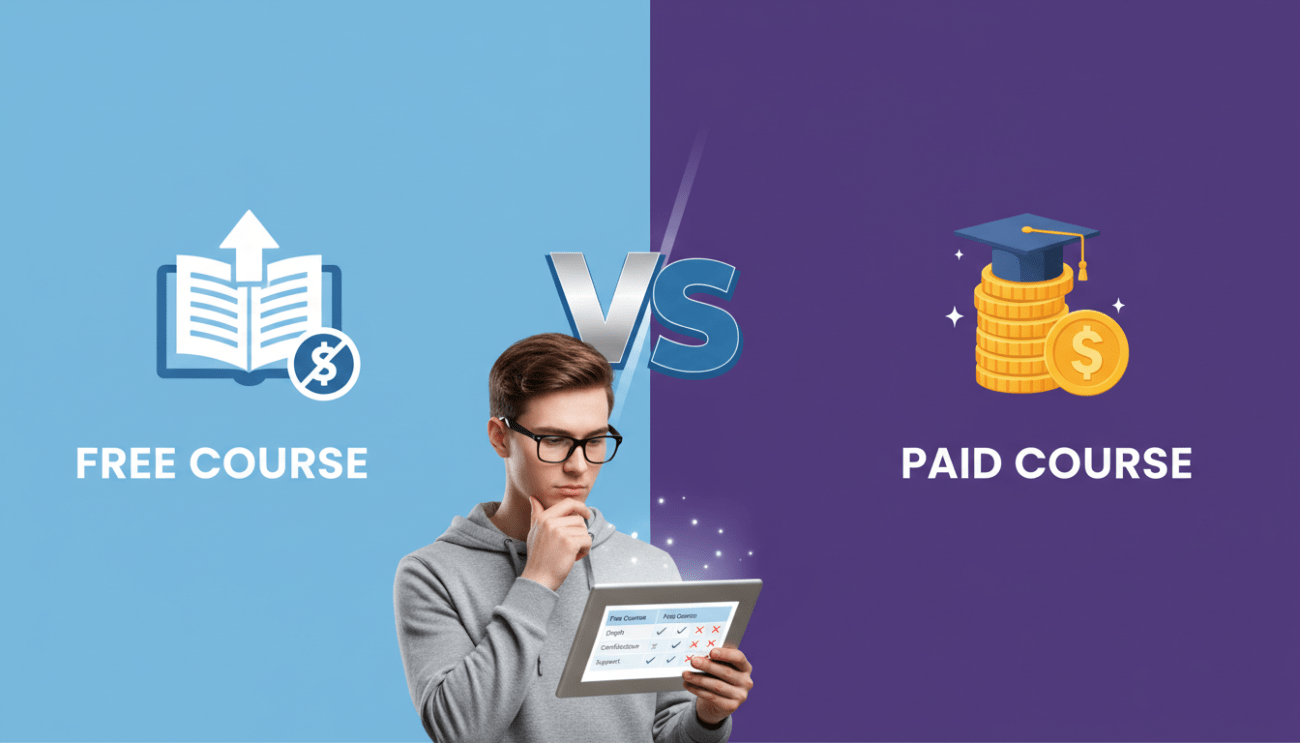
| Feature | Free Courses (Audit/YouTube) | Paid Courses (Certificates/Bootcamps) |
|---|---|---|
| Content Access | Full access to videos and readings. | Full access + interactive labs/assignments. |
| Certification | None or “Participation” badge. | Verified, industry-recognized certificate. |
| Feedback | Peer forums (if available). | Graded assignments and instructor feedback. |
| Mentorship | None (Self-guided). | Direct access to mentors or TAs. |
| Structure | Loose or non-existent. | Rigid roadmap with deadlines. |
The “Information is Free” Reality
In 2026, it is a fact that almost any technical or creative skill can be learned for free. As noted by users on Reddit’s r/GetStudying, the content itself is rarely the “product.” For example, Andrej Karpathy’s YouTube series on AI is widely considered “gold standard” material that is superior to many $1,000 corporate courses.
Trust and Transparency: The Hidden Costs of “Free”
While a course might not cost money, it is never truly “free.” Understanding these trade-offs is crucial for a beginner.
1. The Discipline Tax: The Cost of “No Skin in the Game”
The biggest “cost” of a free course is the high abandonment rate. Without “skin in the game” (financial investment), it is incredibly easy to quit when the material gets difficult. This is a psychological phenomenon often referred to as the “sunk cost fallacy” in reverse—when we haven’t paid for something, we don’t feel the need to “get our money’s worth.”
- The Reality: Research from the University of California, Riverside suggests that while online learners can retain up to 60% more information than in-person students, the lack of a structured environment in free courses often leads to procrastination.
- The Trade-off: You save money, but you pay in “mental overhead.” You have to be your own teacher, your own registrar, and your own motivator. For many beginners, this is a recipe for a half-finished course.
2. Privacy and Data Harvesting: You Are the Product
Free platforms often treat your data as the currency. When you sign up for a “free” course on a smaller, unverified platform, you are often opting into a sophisticated marketing funnel.
- The Reality: Your learning habits, contact information, and even your progress may be sold to recruiters or used to target you with expensive “upsell” offers. In 2026, data is more valuable than a $20 course fee.
- The Trade-off: You get the knowledge for “free,” but you may find your inbox flooded with “exclusive” offers for $2,000 bootcamps or “guaranteed” job placement services that are often less than transparent about their success rates.
3. Content Decay: The “Frozen in Time” Problem
Free resources, especially on platforms like YouTube, are often “set and forget.” A creator might upload a brilliant tutorial in 2024, but by 2026, the software has updated, the API has changed, or the industry best practices have shifted.
- The Reality: Paid platforms like LinkedIn Learning, Udemy, or Coursera have a financial incentive to keep their content updated. If a course becomes outdated, students leave bad reviews, and the platform loses money.
- The Trade-off: With free content, you might spend three hours troubleshooting a problem that only exists because the tutorial is using an old version of the software. With paid content, you are paying for the peace of mind that the material is current.
4. The “Certificate of Participation” vs. “Verified Credential”
There is a massive difference between a PDF that says you “watched the videos” and a verified credential that proves you “passed the exams.”
- The Reality: Many free courses offer a “Certificate of Completion.” While this looks nice on a LinkedIn profile, savvy recruiters in 2026 know that these can often be obtained by simply letting the videos play in the background.
- The Trade-off: Paid courses often require identity verification (like a webcam proctored exam or a government ID check) and graded assignments. This “friction” is exactly what gives the certificate its value in the eyes of an employer.
Expertise and Experience: When Should You Pay?
Based on community feedback and industry trends, there are three specific scenarios where paying for a course is a smart investment.
1. When the “Badge” Matters for Employment
If you are applying for a job in a regulated or traditional industry (like Healthcare, Finance, or Government contracting), a “YouTube certificate” won’t cut it. Employers in 2026 are increasingly looking for Accredited Certifications.
- Example: A Google Professional Certificate on Coursera carries weight because it is a verified program with graded assessments.
- Attribution: According to DigitalDefynd, professionals with relevant, verified certifications can command salaries up to 15% higher than those without.
2. When You Need a “Roadmap,” Not Just a “Video”
The value of a paid course is often the curriculum design. A beginner doesn’t know what they don’t know. A paid course provides a logical path from A to Z, saving you dozens of hours of “searching for the next step.”
- Community Insight: As one Reddit user put it, “I pay for the structure. I could find the info for free, but I’d spend half my time just figuring out what to learn next.”
3. When the Skill Requires “Hands-On” Feedback
Skills like writing, coding, or graphic design are difficult to master in a vacuum. Paid courses often include graded projects or code reviews. Having an expert tell you why your approach is wrong is a shortcut that free videos simply cannot provide.
- The “Feedback Loop”: In a free course, if you get stuck on a bug in your code, you might spend two days on Stack Overflow trying to fix it. In a paid course with a dedicated Slack channel or mentor, you can get an answer in two hours. You are paying to compress time.
4. Networking and Peer Support
One of the most overlooked benefits of paid courses is the community. When you pay for a high-end course or a professional certification, you are often joining a private group of like-minded individuals.
- The “Alumni” Effect: Many paid platforms have exclusive job boards or networking events for their graduates. In 2026, where “who you know” is often as important as “what you know,” this access can be the deciding factor in landing an interview.
5. Access to Proprietary Tools and Software
Some paid courses include “student licenses” for expensive software that would otherwise cost hundreds of dollars.
- The “Bundle” Value: If a $200 course includes a six-month license for a $500 software suite, the course is effectively paying for itself. Always check the “What’s Included” section for these hidden gems.
Deep Dive: The “Accreditation” Minefield
For beginners, the word “Accredited” is often thrown around loosely. It is important to distinguish between different types of recognition.
| Type of Recognition | What it Means | Example |
|---|---|---|
| University Partnered | The course is designed or vetted by a university. | Coursera Specializations |
| Industry Certified | The course is recognized by a specific industry body. | CompTIA A+ for IT |
| Platform Verified | The platform confirms you completed the work. | Udemy Certificate |
| Government Regulated | The course meets specific legal standards for a profession. | Real Estate Licensing |
Expert Advice: If a course claims to be “Accredited,” ask by whom. If the answer is “The International Association of Online Learning” (a made-up sounding name), be skeptical. True accreditation comes from recognized bodies like the Council for Higher Education Accreditation (CHEA) or specific industry leaders like Microsoft, Cisco, or SHRM.
Community Experiences: Real Stories from the Trenches
Disclosure: The author of this article did not participate in these discussions; the following is a summary of verified community experiences from platforms like Reddit and Quora.
In a recent thread on r/GetStudying, the consensus was that “Free is for exploring, Paid is for finishing.”
One user shared their experience: “I spent six months ‘learning’ Python on YouTube and felt like I knew nothing. I finally paid $15 for a structured Udemy course with assignments, and it clicked in three weeks. The $15 wasn’t for the videos; it was for the quizzes that forced me to actually code.”
Conversely, another user warned against “over-paying”: “Don’t spend $2,000 on a bootcamp until you’ve finished a $0 ‘Audit’ version of the same topic on edX. If you can’t finish the free version, the $2,000 won’t magically give you the discipline.”
Actionable Guidance: The “Audit First” Strategy
For beginners and early intermediates, we recommend the “Audit First” approach to maximize value and minimize risk.
- Identify the Skill: What exactly do you want to be able to do? (e.g., “Build a website,” not “Learn IT”).
- Find the “Audit” Version: Go to Coursera or edX and look for the course. Click the small “Audit” link to access the videos for free.
- The 25% Rule: Complete the first 25% of the course for free. If you are still engaged and find the material valuable, then consider paying for the certificate or the graded assignments.
- Check for Regional Discounts: Many platforms offer “Financial Aid” or regional pricing. If you are in a developing economy, you can often get the “Paid” version for a fraction of the US price.
- Verify the Credential: Before paying, search LinkedIn for the certificate name. See if people in the jobs you want actually have that badge on their profile.
Final Thoughts: The ROI of Learning
In 2026, the “best” course isn’t the most expensive one—it’s the one you actually finish. Free courses are an incredible gift for the curious, but they require a level of self-discipline that most beginners haven’t yet developed.
The Bottom Line: Use free resources to explore your interests and build a foundation. Invest in paid courses when you need verified credentials, expert feedback, or the structural support to cross the finish line.
Sources and Attribution
- Learning Retention Data: Sourced from the University of California, Riverside’s 2024 Study.
- Salary Impact: Verified via DigitalDefynd’s 2026 Certification Report.
- Employer Sentiment: Cross-referenced with Indeed’s 2025 Career Advice on Certifications.
- User Sentiment: Summarized from Reddit’s r/GetStudying and r/CareerGuidance.
- Platform Insights: Provided by Forbes Advisor’s 2024 Education Guide.