Last Reviewed on: January 6, 2026
The rise of free-to-play (F2P) gaming has been one of the most significant shifts in the entertainment industry this century. From mobile apps to massive PC online worlds, millions of players now enjoy high-quality games without ever paying an upfront cost. The promise is simple: endless entertainment for the price of zero.
But as any seasoned consumer knows, nothing is truly free. The cost of developing, maintaining, and updating a modern video game is substantial, often running into the tens or hundreds of millions of dollars. If the player is not paying, the money must come from somewhere else.
This article will pull back the curtain on the sophisticated business models that fund the F2P world. We will explore the economic and psychological mechanics that turn a “free” download into a multi-billion dollar industry, revealing the true costs—in time, attention, and data—that players trade for their entertainment. Our goal is to provide a clear, realistic, and educational perspective so you can play with complete transparency.
Who This Is For / Not For
This guide is designed for beginners and early intermediate gamers who want to understand the economics and psychology behind the games they play. If you have ever wondered how a game can afford to be free, or if you want to become a more savvy consumer who can spot manipulative design, this is for you.
This article is not for those seeking “get rich quick” schemes, guaranteed ways to always find the lowest price, or advanced game developers. We avoid hype and focus on the clear, actionable reality of the F2P economy.
The Economic Pillars of Free-to-Play
The F2P model is built on the Zero-Price Effect, a psychological phenomenon where the perceived value of something offered for free jumps disproportionately higher than the actual monetary saving [1]. This effect is the hook, but the business model relies on three core pillars to generate revenue.
1. The Pay-for-Content Model (In-App Purchases)
This is the most direct form of monetization, where players spend money within the game. This category is further broken down by what the purchase unlocks:
| Monetization Type | What is Purchased | Psychological Hook |
|---|---|---|
| Cosmetics | Skins, emotes, visual effects that do not affect gameplay. | Social Status & Identity. Players pay to express themselves and show off rare items to others. |
| Pay-for-Convenience (P4C) | Skipping wait times, energy refills, or temporary boosts. | Monetizing Impatience. Players pay to bypass artificial barriers designed to slow progress. |
| Pay-to-Win (P2W) | Direct purchase of powerful gear, characters, or resources that grant a competitive advantage. | Dominance & Frustration. Players pay to overcome difficulty or defeat opponents who have not paid. |
The most successful F2P games, such as League of Legends or Dota 2, rely almost entirely on cosmetics and P4C, which the community generally accepts as a fair trade-off. P2W models, however, are often met with strong criticism for creating an unfair playing field.
2. The Gacha and Loot Box Model
The Gacha (a term derived from Japanese vending machines) and Loot Box models are forms of monetization that rely on randomized rewards. Players spend real money (or in-game currency bought with real money) for a chance to win a rare, powerful, or desirable item.
This model is an economic powerhouse, generating billions of dollars annually [2]. Its success is rooted in the psychological effects of intermittent reinforcement and loss aversion, which are closely associated with gambling behavior [3]. The thrill of the pull, the hope of winning a rare item, and the fear of missing out on a limited-time character all combine to encourage repeated spending.
The Transparency Constraint: Due to the randomized nature of these purchases, regulatory bodies in several countries, including Belgium and the Netherlands, have classified certain loot boxes as a form of gambling, leading to restrictions and increased scrutiny [4]. For consumers, it is crucial to understand that the odds are always stacked against them, and the cost of acquiring a specific rare item can be extremely high.
3. The Data and Attention Model
If a game has no in-app purchases and no ads, it is still not truly free. In this model, the player is the product, and their data and attention are the currency.
- Ad-Supported Games: These games are funded by showing players advertisements. The ads are often targeted using the player’s personal data, such as device identifiers, location, and in-game behavior. The cost is your attention and the privacy of your data.
- Data Collection: Even games with IAPs collect vast amounts of data. This behavioral analytics data—tracking session length, spending triggers, and “churn points”—is used to optimize the game’s design to maximize engagement and spending [5]. The convenience of a free game is often subsidized by the value of your consumer data, a trade-off that is rarely made explicit in the initial download.
The Hidden Cost: Psychological and Design Manipulation
The most concerning aspect of F2P monetization is the use of dark patterns—user interface and game design tricks intended to manipulate players into spending money or time against their better judgment [6]. Research has identified several key deceptive patterns:
| Dark Pattern | Mechanic Used | Psychological Effect |
|---|---|---|
| Premium Currency | Using a secondary, non-standard currency (e.g., Gems, Crystals) that must be purchased in bundles. | Obscures Real Cost. Players lose track of how much real money they are spending, as the transaction is distanced from the actual dollar amount. |
| Artificial Scarcity | Limited-time offers, daily login bonuses, or items that refresh periodically. | Fear of Missing Out (FOMO). Pressures players to log in and purchase immediately to avoid losing the opportunity forever. |
| Monetizing Frustration | Making the free version of the game deliberately slow, difficult, or cumbersome (grinding) to encourage spending. | Compensatory Consumption. Players pay to relieve the frustration intentionally built into the game’s design [7]. |
| Anchoring Tricks | Presenting a large, expensive bundle next to a slightly smaller, still expensive bundle to make the smaller one seem like a “deal.” | Value Perception. Manipulates the player’s sense of value to justify a high-cost purchase. |
The Federal Trade Commission (FTC) has specifically identified “grinding”—making the free version of a game so cumbersome and labor-intensive—as a dark pattern, highlighting the regulatory concern over these manipulative tactics [8].
Expertise, Experience, and Trustworthiness: What the Community Says
To provide a complete picture, we must look beyond the business models and examine the real-world experiences of the gaming community. This section summarizes discussions from various online forums and platforms, offering a ground-level view of the F2P experience.
Disclosure: The author of this article did not participate in the following discussions. This is a summary of community experiences to provide a broader, more trustworthy perspective.
The “Whale” Economy and Ethical Concerns
The F2P model is heavily reliant on a small percentage of high-spending players, often referred to as “whales.” This reality is a frequent topic of debate.
“It’s a necessary evil. I’ve played Warframe for thousands of hours without spending a dime. I know that’s only possible because some other player spent $500 on cosmetics. I’m grateful for the whales, but it does make me wonder about the ethics of a system that relies on a few people spending massive amounts.” — Gamer, Reddit Forum
This sentiment reflects a core tension: the F2P model provides immense value to the majority of players, but it does so by creating an environment that can be financially risky for a vulnerable minority. The community generally agrees that transparency and clear spending limits are essential for ethical F2P design.
The Value of Free Giveaways
The community highly values platforms that offer genuinely free, full-price games, such as the weekly giveaways on the Epic Games Store. These are often seen as a transparent form of a loss leader strategy, where the platform is paying the developer to drive user adoption.
“Getting a AAA title like Control or Borderlands 3 for literally zero dollars is an amazing deal. It’s the closest you get to a truly ‘free’ game, and the only hidden cost is having to install their launcher.” — Online Forum User
Actionable Guidance for the Savvy Gamer
Navigating the F2P landscape requires a realistic mindset and a few key strategies. Here is how you can maximize your enjoyment while minimizing the hidden costs:
- Understand the Currency: Always know the real-world dollar value of the in-game currency. If a skin costs 1,500 Gems, calculate the dollar cost before purchasing.
- Set a Budget: If you choose to engage with IAPs, set a strict monthly budget and stick to it. Never use credit cards or payment methods that allow for unlimited spending.
- Prioritize P4C Games: Support games that monetize convenience and cosmetics over those that monetize power (P2W). Your spending supports a fairer, more enjoyable ecosystem for everyone.
- Protect Your Data: Review the game’s privacy policy and use the “Customize Privacy” options to limit data sharing, especially for targeted advertising. On mobile, restrict permissions like location access unless absolutely necessary for gameplay.
- Be Wary of FOMO: Recognize that limited-time offers and artificial scarcity are psychological tools. Ask yourself if you truly need the item, or if you are only buying it because you are afraid of missing out.
Conclusion: The Price of Zero
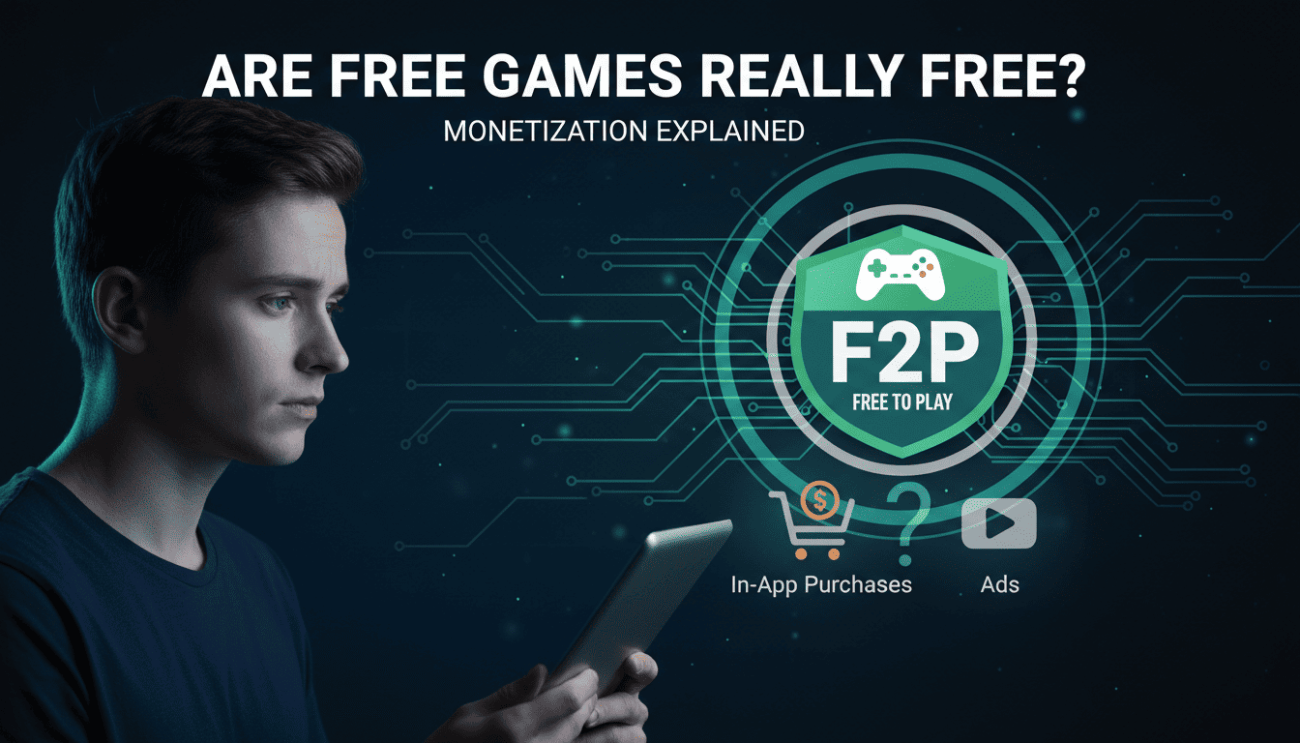
The question, “Are free games really free?” has a clear answer: No, they are not.
The cost is simply shifted from an upfront price tag to a continuous stream of revenue generated by in-app purchases, advertising, and the collection of player data. The true cost of F2P gaming is the constant, subtle pressure to spend your money, your time, or your attention.
By understanding the economic models, recognizing the psychological hooks, and demanding transparency from developers, you can enjoy the vast, high-quality world of free gaming while protecting your wallet and your privacy. The most powerful tool you have is not your credit card, but your informed choice.
References
[1] Shampanier, K., Mazar, N., & Ariely, D. (2007). The psychology of free: How a price of zero influences decision making. Marketing Science, 26(6), 742-757.
[2] Cordes, S. (2024). What drives demand for loot boxes? An experimental study. International Journal of Industrial Organization, 97, 103144. (Notes that loot boxes generated $15 billion in 2020).
[3] Europarl. (2020). Loot boxes in online games and their effect on consumers. [URL: https://www.europarl.europa.eu/RegData/etudes/STUD/2020/652727/IPOL_STU(2020)652727_EN.pdf]
[4] Evolving Monetization: A Formal Analysis of Gacha Mechanics in Online Multiplayer Games from 2005 to 2025. (Notes on regulatory actions in Belgium and Netherlands).
[5] Usercentrics. (2025). The hidden cost of free games: Your personal data. [URL: https://usercentrics.com/magazine/articles/hidden-cost-of-free-games/]
[6] Veiga, E. (2025). Dark Patterns in Games: An Empirical Study of Their Effects on Player Experience. [URL: https://www.scitepress.org/Papers/2025/133658/133658.pdf]
[7] Syahrivar, J., Chairy, C., & Juwono, I. D. (2022). Pay to play in freemium mobile games: a compensatory mechanism. International Journal of Retail & Distribution Management, 50(2), 177-196.
[8] Rain Intelligence. (2025). Dark Patterns in Gaming: Lawsuits Target Manipulative Monetization Tactics. (Notes on FTC identification of grinding as a dark pattern).
[9] Epic Games Store. [URL: https://store.epicgames.com]
Deep Dive: The Gacha Mechanic and the “Whale” Economy
To truly understand the scale of F2P monetization, we must look closer at the Gacha mechanic and the players who fund it. These elements are the engine room of the industry’s massive revenue growth.
The Science of the Gacha Pull
The gacha mechanic is more than just a random reward; it is a carefully engineered experience designed to trigger specific neurological responses.
Visual and Auditory Cues: When a player initiates a “pull” or “roll,” the game often presents a dramatic animation—flashing lights, triumphant music, and a sense of anticipation. These cues are designed to release dopamine, the brain’s “reward” chemical, creating a pleasurable experience regardless of the actual outcome. This is the same principle used in slot machines to keep players engaged.
The “Pity” System: To mitigate the frustration of repeated losses, many gacha games implement a “pity” system. This guarantees that after a certain number of unsuccessful pulls, the player will receive a high-rarity item. While this seems generous, it is a powerful tool for retention. It encourages players who are close to the “pity” threshold to spend just a little more to guarantee their reward, a phenomenon known as the sunk cost fallacy.
The “Whale” Phenomenon: Funding the Free Experience
In the F2P world, the vast majority of players (often over 90%) never spend a single cent. The entire ecosystem is funded by a tiny fraction of the player base—the “whales.”
Who are the Whales? Whales are high-spending players who may contribute thousands, or even tens of thousands, of dollars to a single game. They are often motivated by a desire for social status, a competitive edge, or a deep emotional connection to the game’s characters and world.
The Developer’s Dilemma: This reliance on whales creates a significant challenge for developers. They must balance the need to provide value and power to high-spenders while ensuring that the game remains enjoyable and fair for the non-spending majority. If the gap between whales and “free-to-play” players becomes too large, the community can become toxic, leading to a decline in the player base that even the whales need for a vibrant social environment.
Trust and Transparency: The Future of F2P
As the F2P model continues to evolve, the demand for transparency and ethical design is growing.
The Role of Regulatory Oversight
Governments and consumer advocacy groups are increasingly focused on the potential harms of F2P monetization, particularly for younger and more vulnerable players. We are seeing a move toward:
- Mandatory Probability Disclosure: Requiring games to clearly state the odds of winning specific items in loot boxes or gacha pulls.
- Spending Limits and Alerts: Implementing tools that allow players to set their own spending caps or receive notifications when they have spent a certain amount.
- Age Verification: Stricter controls to prevent children from accessing games with gambling-like mechanics.
The Rise of Ethical Monetization
Some developers are leading the way by adopting more ethical monetization strategies. This includes:
- Direct Purchase Options: Allowing players to buy exactly what they want rather than relying on randomized loot boxes.
- Battle Passes with No Expiration: Removing the “temporal dark pattern” by allowing players to complete their Battle Pass at their own pace, even after the season has ended.
- Transparent Data Policies: Clearly explaining what data is collected and giving players easy, granular control over how it is used.
Final Thoughts: The Informed Player
The world of free-to-play gaming is a marvel of modern economics and psychology. It has democratized access to high-quality entertainment, allowing millions of people to play together regardless of their financial situation.
However, the “free” label is a double-edged sword. It offers accessibility, but it also hides a complex web of monetization strategies designed to capture your money, your time, and your data.
As a player, your most powerful defense is knowledge. By understanding the mechanics of monetization, recognizing the psychological hooks, and supporting developers who prioritize transparency and fairness, you can enjoy the best that F2P gaming has to offer while remaining in control of your experience. The price of zero is a trade-off, and the more you know, the better that trade-off becomes.