Last reviewed and updated on January 6, 2026. Note: The availability of rewards and specific platform terms may vary by region (e.g., U.S. vs. UK vs. Canada). Always check the current terms of service for any platform you join.
“Congratulations! You’ve won a $500 Amazon Gift Card!”
If you have spent more than five minutes on the internet, you have likely seen a variation of this message. It pops up in your email, slides into your social media DMs, and occasionally arrives as an urgent text message. For a beginner, these offers are tantalizing. For an intermediate user, they are suspicious.
The truth is that legitimate free gift cards do exist, but they are never truly “free” in the sense of getting something for nothing. You are always trading something—usually your time, your data, or your shopping habits. This guide will help you distinguish between the real opportunities and the sophisticated scams that dominate the landscape in 2026.
Who This Guide Is For (and Who It’s Not)
This guide is for:
- Beginners who want to earn a few extra dollars for coffee or video games without getting scammed.
- Early intermediates looking for the most efficient “GPT” (Get-Paid-To) platforms.
- Privacy-conscious users who want to know exactly what data they are giving up in exchange for rewards.
This guide is NOT for:
- People looking for a full-time income. You cannot pay a mortgage with Swagbucks.
- Anyone unwilling to do the work. Legitimate offers require completing tasks, surveys, or making purchases.
- Users looking for “hacks” or “generators.” Any site promising a “Gift Card Generator” is a 100% confirmed scam.
The Reality of “Free”: Understanding the Trade-offs
Before we list the legitimate sites, we must address the “cost” of these rewards. Companies aren’t giving away gift cards out of the goodness of their hearts; they are buying something from you.
- Your Time: To earn a $10 gift card, you might spend 2 to 3 hours answering surveys or playing mobile games. Your “hourly rate” on these sites is often below minimum wage.
- Your Data: Market research companies want to know your age, income, and buying preferences. When you take a survey, you are selling your personal profile.
- Your Privacy: Many rewards apps track your location or monitor your app usage to see how you interact with products.
- Your Attention: Some platforms, like MyPoints, require you to watch advertisements or read promotional emails to earn points.
“If you aren’t paying for the product, you are the product.” — A fundamental rule of the digital rewards economy.
1. The “Big Three”: Legitimate Rewards Platforms
These platforms have been around for over a decade and have paid out hundreds of millions of dollars to users. They are the “safe bets” in the industry.
Swagbucks
Swagbucks is the most famous rewards site. You earn “SB” (points) for taking surveys, watching videos, searching the web, and shopping online.
- Why it’s legit: They have paid out over $900 million to members since 2008. They are owned by Prodege, a reputable media company.
- The Reality Check: As noted in Swagbucks’ own security update, scammers often impersonate the brand via text message. Legitimate Swagbucks offers will never come via an unsolicited text message asking for your Social Security number.
- User Experience: “I make about $50 a month on Swagbucks by doing the daily poll and playing one mobile game. It’s not much, but it pays for my Netflix,” says one user on the r/Swagbucks community. (Note: Summarized community sentiment.)
InboxDollars
Similar to Swagbucks, InboxDollars pays you for activities you already do online. The main difference is that they pay in actual dollars rather than a point system, which many beginners find easier to understand.
- The Trade-off: The “payout threshold” is often higher (e.g., $15 or $30), meaning you have to work longer before you can actually withdraw your money.
Rakuten
Rakuten (formerly Ebates) focuses on “Cash Back” shopping. You don’t take surveys; you simply shop at your favorite stores through their link, and they give you a percentage of your purchase back as a gift card or PayPal cash.
- Why it’s legit: They partner with thousands of major retailers like Walmart, Target, and Sephora. They get a commission for sending you to the store and share that commission with you.
2. Tech Giants: Rewards from Google and Microsoft
If you are wary of third-party sites, you can earn rewards directly from the companies that build your browser and phone software.
Microsoft Rewards
This is arguably the most efficient rewards program in 2026. You earn points for searching on Bing, using the Edge browser, and playing Xbox games.
- The Advantage: It is integrated into Windows and Xbox. You can earn enough points for a $5-10 gift card every month just by doing your normal web searches.
- The Trade-off: Microsoft is using this to gain market share from Google. By participating, you are helping them build their search data.
Google Opinion Rewards
This app sends you very short surveys (usually 1-3 questions) based on your recent location history or YouTube viewing.
- The Advantage: Surveys take less than 30 seconds.
- The Reality: You might only get 2 or 3 surveys a week. It is a slow way to earn, but the “effort-to-reward” ratio is the best in the industry.
3. Mobile Gaming and Receipt Scanning
If you spend a lot of time on your phone or do the grocery shopping for your household, these apps are highly effective.
Mistplay (Android Only)
Mistplay pays you to discover and play new mobile games. The longer you play, the more “Units” you earn, which can be traded for Amazon, Google Play, or Starbucks gift cards.
- The Catch: The earning rate slows down significantly as you level up in a game, encouraging you to constantly switch to new (and often ad-heavy) games.
Fetch Rewards
Fetch is the easiest receipt-scanning app. You take a photo of any grocery, restaurant, or gas station receipt, and you get points.
- The Reality: You need to scan dozens of receipts to get a $5 gift card. It is a slow burn, but it requires almost zero effort.
4. Red Flags: How to Spot a Gift Card Scam in 2026
Scammers have become incredibly sophisticated, using AI to generate realistic-looking emails and websites. Here is how to protect yourself:
1. The “Processing Fee” Scam
If a site says you have won a $1,000 gift card but you need to pay a $5 “shipping” or “verification” fee, it is a scam.
- The Rule: You should never have to pay money to get “free” money.
2. The “Urgent” Text Message
Scammers often send texts saying your “Amazon account is locked” or you have an “unclaimed reward.” They include a link to a site that looks like Amazon but is actually a phishing page designed to steal your login credentials.
- The Fix: Never click links in unsolicited texts. Go directly to the official website (e.g.,
amazon.com) to check your account status.
3. The “Gift Card Generator”
You will see YouTube videos or TikToks claiming to show a “secret hack” to generate unlimited gift card codes.
- The Reality: These sites usually force you to download “verification apps” that are actually malware or lead you through an endless loop of surveys that never pay out.
4. Social Media “Giveaways”
Be wary of Instagram or Twitter accounts that ask you to “Like, Retweet, and Click the Link in Bio” for a chance to win a $500 gift card.
- The Trap: These are often “engagement bait” used to build a large following quickly, which is then sold to a different company. The link in the bio often leads to a data-harvesting survey.
5. Maximizing Your Earnings: Pro Tips for Beginners
If you decide to join these platforms, do it strategically to protect your privacy and save time.
- Use a Dedicated Email: Create a separate Gmail account (e.g.,
yourname.rewards@gmail.com) just for these sites. This keeps your main inbox clean and makes it easier to track your earnings. - Be Honest on Surveys: Survey sites have “trap questions” to see if you are paying attention. If you lie or rush through, they will ban your account and you will lose your pending rewards.
- Check for “Sign-up Bonuses”: Most legitimate sites, like InboxDollars, offer a $5 bonus just for confirming your email.
- Set Realistic Expectations: Treat this as a way to earn “fun money,” not a way to pay bills. If you expect to get rich, you will be disappointed and more likely to fall for a scam.
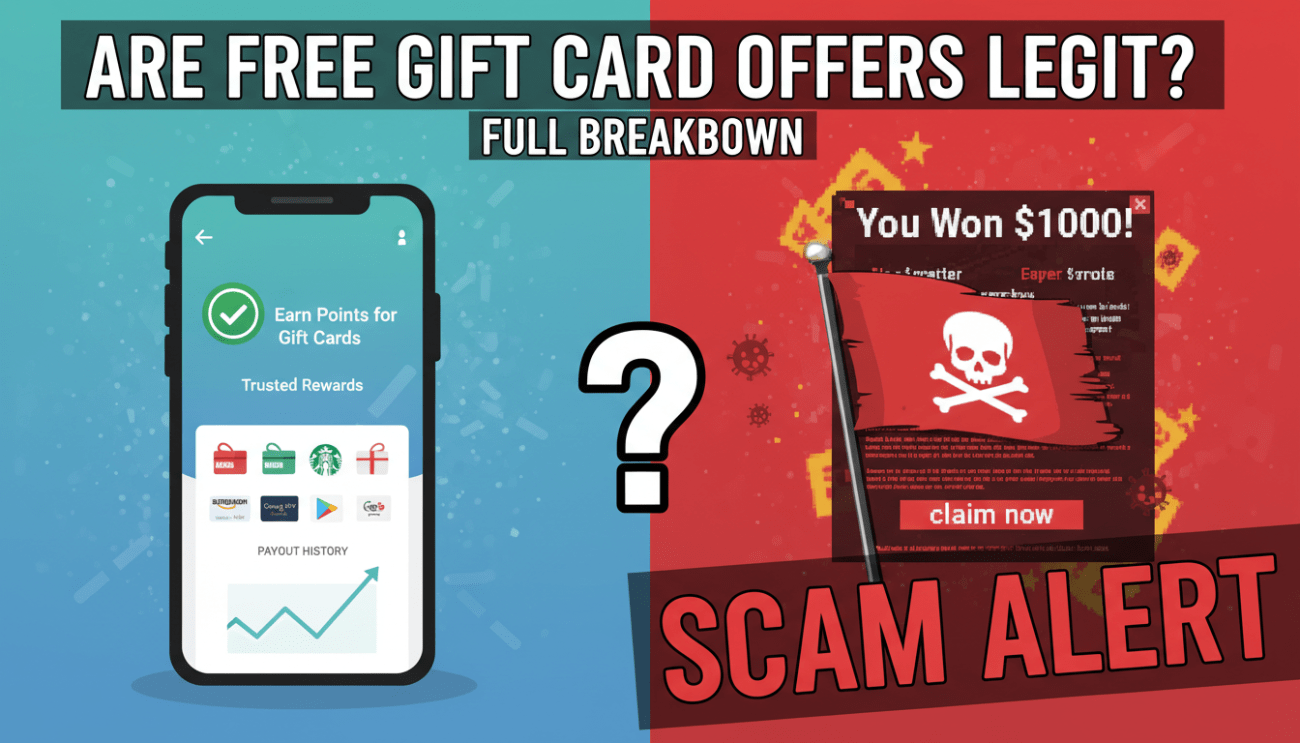
Summary Table: Legitimate vs. Scam Offers
| Feature | Legitimate Offer | Scam Offer |
|---|---|---|
| Cost to Join | Always free. | Asks for a “fee” or “deposit.” |
| Earning Method | Tasks, surveys, or shopping. | “You won” without entering anything. |
| Payout Speed | Takes days or weeks of effort. | Promises “Instant” $500+ rewards. |
| Contact Method | Official app or website dashboard. | Unsolicited texts or social media DMs. |
| Information Requested | Demographics (age, zip code). | SSN, Bank Password, or CC info. |
Real-World Constraints: Why You Might Get “Disqualified”
One of the biggest frustrations for beginners is being “disqualified” from a survey after spending 10 minutes on it.
- Why it happens: Brands are looking for a specific “persona” (e.g., “moms aged 30-40 who buy organic milk”). If you don’t fit that persona, the survey ends.
- The Trade-off: You might get a “consolation prize” of 1 or 2 cents, but your time is effectively lost. This is the biggest “hidden cost” of survey sites.
User Testimonials: Lessons from the Community
Note: The author of this article did not participate in these experiences; these are summaries of documented community discussions from platforms like Reddit, Trustpilot, and specialized “beermoney” forums.
- The “Slow and Steady” Winner: “I’ve used Swagbucks for three years. I don’t do the high-paying offers because they feel like too much work. I just do the daily goals. I’ve earned about $600 in Amazon gift cards total. It paid for my last two Christmas seasons.”
- The Scam Victim: “I got a text saying I won a $500 Shein gift card. I clicked the link and it asked for my credit card to ‘verify my age.’ I was stupid and did it. Within an hour, there were $200 in charges on my card. I had to cancel the card and file a fraud report.”
- The “Receipt” Enthusiast: “Fetch Rewards is my favorite. It takes 5 seconds to scan a receipt. I only get about $25 a year, but it’s literally for doing nothing I wasn’t already doing.”
- The “Microsoft” Fan: “I switched my default browser to Edge and my search engine to Bing. I get a $5 Amazon card every 3 weeks just for doing my normal school research. It’s the only rewards program that doesn’t feel like a chore.”
Final Thoughts: Are They Worth It?
Are free gift card offers legit? Yes, the ones from established platforms are. However, they are a low-yield side hustle. They are perfect for students, stay-at-home parents, or anyone with a few minutes of “dead time” during their commute.
If you stick to the “Big Three” (Swagbucks, InboxDollars, Rakuten) or the tech giant programs (Microsoft, Google) and never pay a cent to join a platform, you can safely earn rewards. Just remember: if an offer sounds too good to be true—like a $1,000 gift card for clicking a single link—it is almost certainly a scam.
Stay skeptical, protect your data, and enjoy your (hard-earned) freebies!
Disclaimer: This article is for informational purposes only. The author is not affiliated with the companies mentioned. While we strive for accuracy, terms and conditions for rewards platforms change frequently. Always practice safe browsing habits and use updated antivirus software.

Alex Morgan has spent over a decade deconstructing the “fine print” of the digital economy. Since 2014, Alex has been a lead contributor at AllFreeStuff.com, where they specialize in vetting consumer offers, subscription models, and emerging AI technologies to ensure users find genuine value without compromising their data privacy.
Why Trust Alex’s Recommendations?
- Hands-On Vetting: Alex personally signs up for every service reviewed on this site, testing the “cancelation friction” and data-sharing policies of over 500+ digital platforms.
- Industry Expertise: With a background in digital marketing and consumer psychology, Alex identifies the difference between “value-add” free tiers and “data-harvesting” traps.
- Transparency First: Alex maintains a strict “no-pay-to-play” policy for reviews. Every AI tool and product sample is tested under the same rigorous benchmarks: ease of access, true cost of ownership, and utility.
Before joining AllFreeStuff.com, Alex worked as a freelance technical researcher, helping consumers navigate the shift from physical coupons to the complex world of SaaS (Software as a Service) trials. When not testing the latest LLMs or hunting for mail-in samples, Alex can be found advocating for better data transparency laws in the digital marketplace.