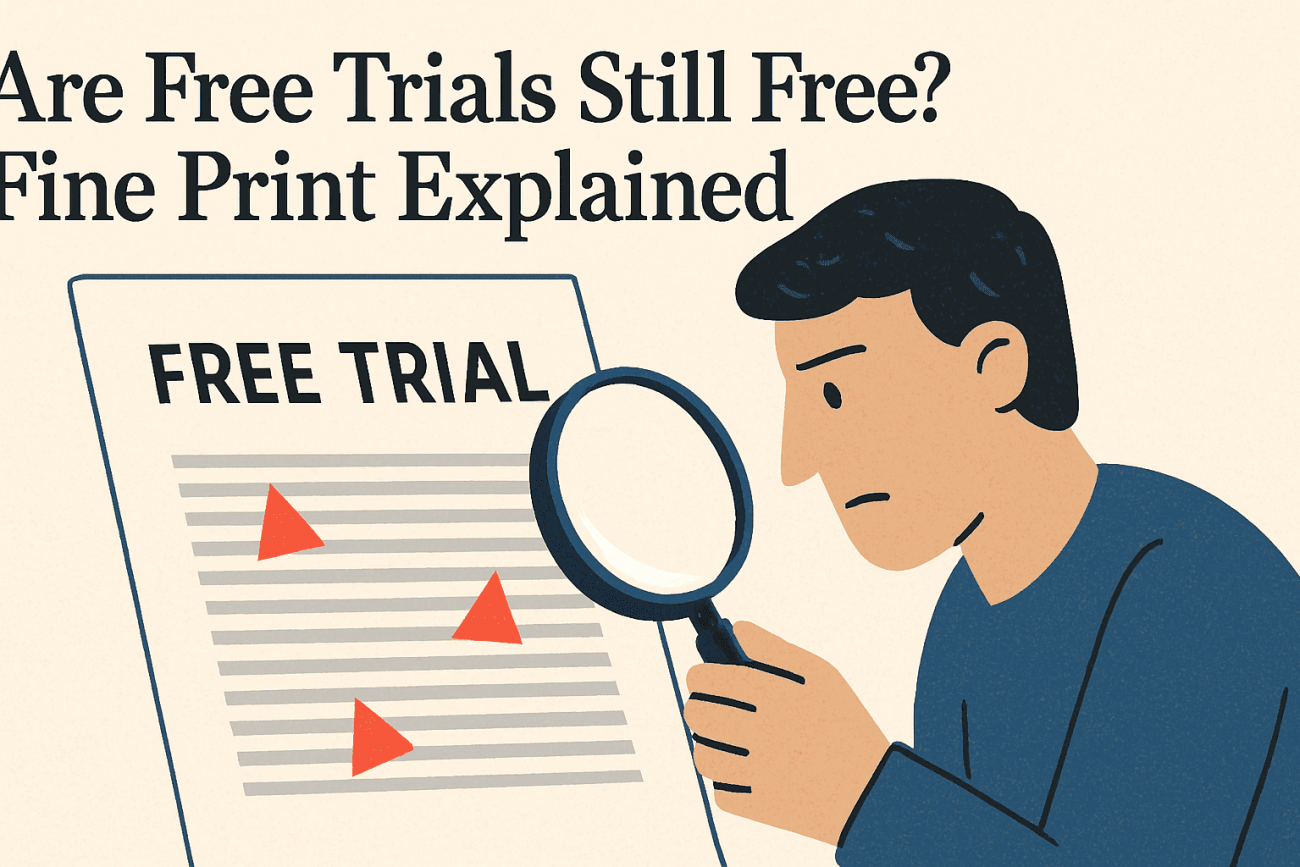
Last reviewed on January 11, 2026. Please note that consumer protection laws and corporate policies are subject to regional variability and frequent legal updates.
The allure of the “free trial” is one of the oldest tricks in the digital marketing playbook. It promises a risk-free way to test a service, yet for many, it ends in a frantic call to a bank or a surprise $200 charge on a credit card statement. In 2026, the landscape of free trials has become more complex, with shifting federal regulations and increasingly sophisticated “dark patterns” designed to keep you subscribed. This guide breaks down the reality of modern free trials, helping you navigate the fine print without losing your shirt.
Who This Is For / Not For
- This is for: Beginners and intermediate consumers who want to understand the mechanics of subscription traps, learn how to protect their financial data, and find actionable ways to enjoy free services safely.
- This is not for: Those looking for “get rich quick” schemes, illegal “hacks” to bypass paywalls, or professional legal advice regarding class-action lawsuits.
The Evolution of the “Free” Trial: From Generosity to Strategy
In the early days of the internet, a free trial was often a simple, time-limited version of a product. You downloaded a piece of software, used it for 30 days, and then it simply stopped working unless you mailed in a check or entered a license key. It was a “positive action” model—you had to choose to pay.
Today, the script has flipped. Most trials are now “negative option” offers. This means that instead of the trial simply ending, the burden is on you to take action to stop a recurring charge. According to the Federal Trade Commission (FTC), dishonest businesses often use these trials to trap consumers into monthly subscriptions that are intentionally difficult to cancel. The psychology is simple: companies bank on your forgetfulness.
While the FTC announced a “Click-to-Cancel” rule in late 2024 aimed at making it as easy to leave a service as it is to join, the legal path has been rocky. In July 2025, the Eighth Circuit Court of Appeals vacated the rule, leaving much of the enforcement to individual state laws and older federal statutes like the Restore Online Shoppers’ Confidence Act (ROSCA). This legal back-and-forth means that as of early 2026, the “ease of cancellation” is still very much a “your mileage may vary” situation.
The Real-World Constraints: What “Free” Actually Costs
We’ve all heard the phrase “if you aren’t paying for the product, you are the product.” In the world of free trials, this is only half-true. Often, you are both the product and the future source of revenue. Even if you cancel on time, you are often trading something valuable for that 7-day window of access.
1. The Privacy Trade-Off
When you sign up for a trial, you aren’t just giving them a credit card number; you are providing a verified email address, often a phone number, and a window into your consumer habits. This data is gold for marketers. Even if you never pay a cent, your data is frequently used for aggressive “re-marketing” or sold to third-party data brokers. Have you ever noticed an uptick in spam calls or targeted ads after signing up for a “free” credit report or fitness app? That isn’t a coincidence.
2. The “Zombie” Subscription and Dark Patterns
A common issue reported by users is the “zombie” charge—where a subscription continues even after a user believes they have canceled. This often happens because of “dark patterns”—user interface designs intended to trick you. For example, the cancellation process might require four or five “Are you sure?” clicks. If you close the tab after the third click, thinking you’re done, the company keeps the subscription active.
3. Regional Variability: The Zip Code Lottery
Your protections depend heavily on where you live. For example, California’s Automatic Renewal Law provides some of the strongest protections in the U.S., requiring businesses to provide a clear, online way to cancel. If you are in the UK or EU, you may benefit from even stricter “cooling-off” periods and mandatory renewal reminders that aren’t available to most U.S. consumers. This creates a “Zip Code Lottery” where two people using the same app might have vastly different rights based on their billing address.
Common Fine Print Traps to Watch For
To stay safe, you need to know exactly where companies hide the “gotchas.” Here are the most frequent tactics used in 2025 and 2026:
| Trap Name | How It Works | Real-World Example |
|---|---|---|
| The 48-Hour Rule | The fine print states you must cancel at least 48 hours before the trial ends. If you cancel 24 hours before, you’re already billed. | Common in streaming services like fuboTV. |
| The “Annual” Default | The trial converts into a full year’s charge (e.g., $120) rather than a monthly one ($10). | Reported by users of Duolingo and Amazon Prime. |
| The $1 “Verification” | A small charge is placed on your card to “verify” it. While usually a “hold,” some sites keep it as a “processing fee.” | Frequently seen in background check sites like Spokeo. |
| Early Termination Fees | A “monthly” plan that is actually a one-year contract. If you cancel in month 3, they charge you 50% of the remaining year. | A long-standing complaint regarding Adobe Creative Cloud. |
| The “Phone-In” Only | You can sign up in 10 seconds online, but to cancel, you must call a support line during limited business hours. | Common in traditional media like The New York Times (though improving). |
Expertise and Experience: What the Community is Seeing
Disclosure: The author of this article did not participate in these specific interactions; the following is a summary of documented community experiences from platforms like Reddit, Trustpilot, and the Better Business Bureau (BBB) as of late 2025.
The impact of these traps is not just theoretical. On community forums like Reddit’s r/ADHD, users frequently share stories of “ADHD taxes”—the high cost of forgetting to cancel a trial. One user noted they nearly lost $199 to a Rosetta Stone renewal because the notification email was buried in their “Promotions” folder.
In the world of language learning, Duolingo users have frequently pointed out how easy it is to “accidentally” opt into a Family Plan trial instead of an Individual one. When the trial ends, the user is hit with a $120+ charge for a year of service they only intended to test for a week.
Similarly, complaints filed with the Better Business Bureau regarding health and fitness apps like BetterMe often highlight the difficulty of confirming a cancellation. Users report that even after following the steps in the app, they received no confirmation email. Without that “paper trail,” disputing the charge with a bank becomes a game of “he-said, she-said.”
Deep Dive: The Psychology of the “Free” Offer
Why do we keep falling for it? Behavioral economists point to a concept called “Loss Aversion.” Once we start using a service—even for a week—we begin to feel a sense of ownership. Losing access feels like a “loss,” which hurts more than the “gain” of keeping our money feels good. Companies use this to their advantage by making the trial just long enough for you to integrate the service into your daily routine.
Furthermore, the “Endowment Effect” kicks in. We value things more highly simply because we possess them. By the time day 7 rolls around, you’ve built a streak on a language app or curated a playlist on a streaming service. The thought of that work disappearing makes the $14.99 charge seem “worth it” in the moment, even if you wouldn’t have paid it upfront.
How to Protect Yourself: Actionable Guidance
You don’t have to stop using free trials altogether. You just need a better system for managing them. Here is a professional’s toolkit for navigating the subscription economy.
1. Use Virtual Credit Cards (The Gold Standard)
Services like Privacy.com allow you to create “virtual” cards with a set spending limit.
- The Strategy: Create a card with a $1 limit for a free trial.
- The Result: If the company tries to charge you $100 later because you forgot to cancel, the transaction will simply fail. You get an email notification that the charge was declined, and you can then go cancel the service at your leisure without the financial sting.
2. The “Cancel Immediately” Strategy
For many services (though not all), you can cancel the trial the same minute you sign up. Most reputable companies—like Netflix or Spotify—will allow you to continue using the service until the trial period expires.
- Warning: Some services, particularly those managed through the Apple App Store, may terminate access the moment you hit cancel. Always check the “Manage Subscription” screen first to see if it says “Your trial will end on [Date]” or “You will lose access immediately.”
3. Set “T-Minus 2” Reminders
Never rely on your memory. Set a calendar alert for two days before the trial expires. Why two days? Because of the “48-hour rule” mentioned earlier. This buffer also gives you time to deal with “customer retention” loops—those annoying screens where they offer you 50% off to stay—or technical glitches in the cancellation portal.
4. Audit Your Mobile Settings Monthly
If you signed up via an iPhone or Android device, your subscription is likely managed through the App Store or Google Play. This is actually a good thing, as it centralizes your cancellations.
- iOS: Settings > [Your Name] > Subscriptions.
- Android: Google Play Store > Profile Icon > Payments & Subscriptions.
Checking these lists once a month is the best way to spot “zombie” subscriptions before they drain your account.
5. Read the “Negative Option” Disclosure
Before you click “Start My Free Trial,” look for a block of text near the button. It will usually say something like: “By clicking ‘Start,’ you agree that after your 7-day trial, you will be charged $99/year unless you cancel.” If you don’t see this, or if it’s hidden behind a tiny “Terms” link, treat the service with extreme caution.
The Future of Free Trials: What to Expect in 2026 and Beyond
As we move further into 2026, expect to see more “AI-driven” subscription management. Banks are increasingly offering features that automatically identify recurring charges and ask if you want to block them. However, companies are also getting smarter, using “micro-transactions” and “credit-based” systems to make the cost of a service feel less like a single, large bill and more like a series of small, ignorable expenses.
The Ethics of the “Free” Model
Beyond the legalities and the technical traps, there is an ethical question at the heart of the modern subscription economy. Is it fair for a company to design a system that profits primarily from human forgetfulness? While some argue that it is the consumer’s responsibility to manage their finances, others point out that the playing field is far from level. Companies spend millions on “growth hackers” and behavioral psychologists to design interfaces that nudge us toward staying subscribed, while the average consumer is just trying to get through their day.
This is why transparency is so critical. A truly “customer-centric” company will send you an email three days before your trial ends, clearly stating the upcoming charge and providing a one-click link to cancel. If a company does the opposite—hiding the trial terms in a tiny font or making the cancellation link invisible—they are essentially admitting that their product isn’t valuable enough to keep you on its own merits. They are relying on friction, not quality, to keep their revenue numbers up.
Actionable Checklist for Your Next Free Trial
Before you sign up for that next “must-have” app, run through this quick checklist to ensure you’re in control:
- Identify the “Negative Option”: Does it require a credit card? If yes, it’s a negative option.
- Find the “Cancel By” Date: Is it 24 hours before? 48 hours? Mark it in your calendar immediately.
- Check for “Annual” Traps: Will it charge you for a month or a year?
- Use a Buffer: Can you use a virtual card or a secondary email address to limit your exposure?
- Test the Exit: Look at the “Manage Subscription” page before you start using the service. If you can’t find it now, you won’t find it when you’re in a rush later.
Final Thoughts
Free trials are a tool, and like any tool, they can be used for or against you. They offer a genuine way to explore new technology and entertainment without upfront cost, but they require a level of “digital hygiene” that many of us weren’t taught in school.
By understanding the “negative option” model, recognizing dark patterns, and using protective measures like virtual cards and calendar alerts, you can enjoy the benefits of “free stuff” without the lingering headache of unwanted charges. Transparency is the best defense: if a company makes it hard to find their cancellation button, they’ve already told you everything you need to know about how they value your business. In the end, the most valuable thing you have isn’t the $14.99 in your bank account—it’s your attention and your data. Protect them accordingly.
This article is for educational purposes. Always read the specific Terms of Service for any product you use, as corporate policies and local laws change frequently. The author is not a financial advisor or legal professional.