Last Reviewed On: January 5, 2026
Introduction: Two Paths to Savings
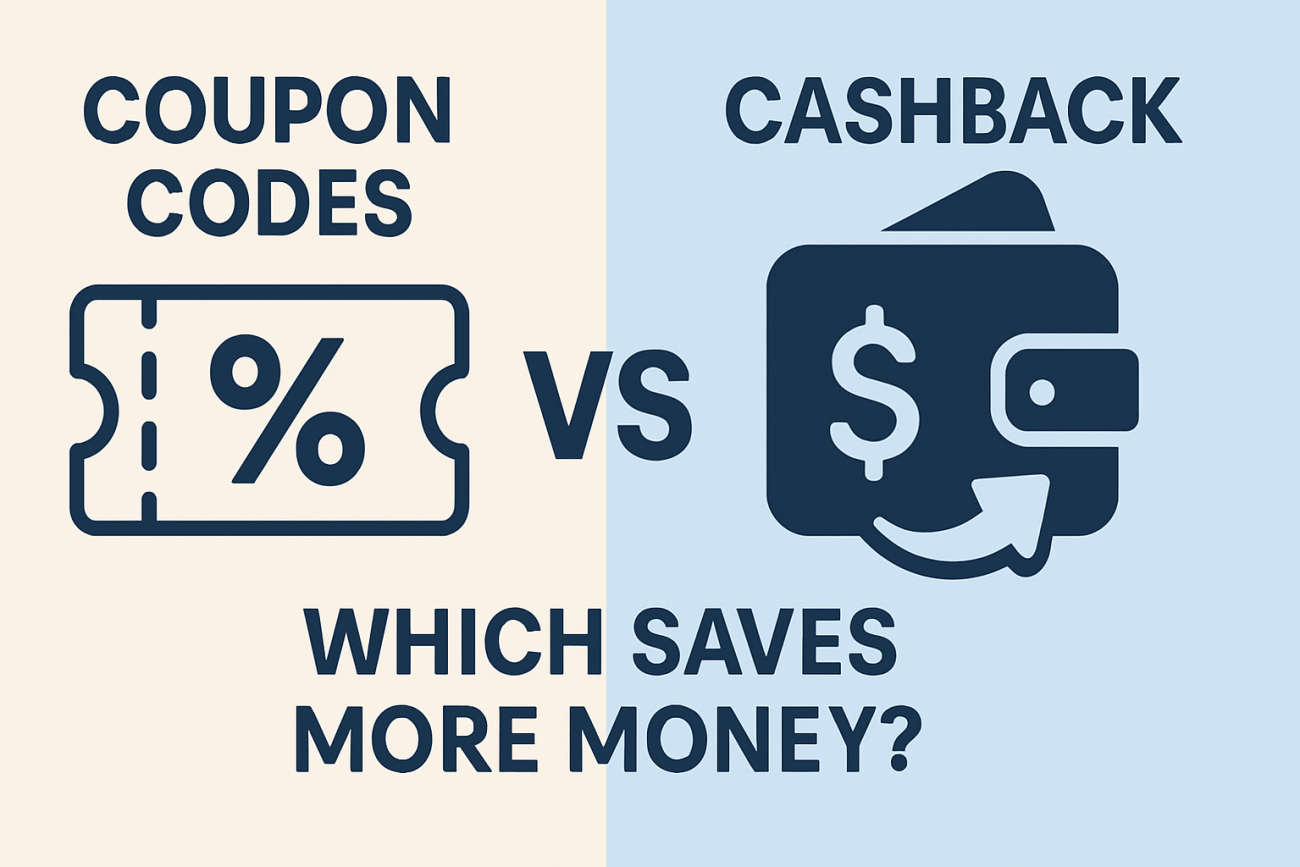
You are standing in the checkout aisle (or at the digital cart) when you realize you have two options: apply a 20% coupon code you found online, or use a cashback app that promises 5% back on your purchase. Which one actually saves you more money? The answer is more nuanced than it seems, and it depends on your shopping habits, the products you buy, and how much effort you are willing to invest.
This guide cuts through the confusion to help you understand when coupons win, when cashback wins, and how to use both strategically to maximize your savings.
Who This Is For / Not For
| Who This Guide Is For | Who This Guide Is Not For |
|---|---|
| Beginners looking to save money on everyday purchases without overcomplicating their routine. | Those seeking to eliminate all spending through extreme couponing (this requires significant time investment). |
| People comfortable with digital tools and apps for tracking and applying discounts. | Individuals who prefer simplicity and do not want to manage multiple apps or browser extensions. |
| Shoppers interested in understanding the mechanics of how savings work before choosing a strategy. | Those expecting to save hundreds of dollars monthly without changing their purchasing behavior. |
| Budget-conscious consumers seeking realistic, actionable guidance on discount strategies. | People prioritizing convenience above all else (coupons and cashback require some effort). |
Understanding the Fundamental Difference
Before comparing which saves more, you need to understand how each works.
Coupon Codes: Immediate Discounts
A coupon code reduces your price at the moment of purchase. If you are buying a $50 item and apply a 20% coupon, you pay $40 immediately. The savings are instant and visible.
How they work:
- You find a coupon code online (from retailer websites, coupon sites, or email newsletters)
- You enter the code at checkout
- The discount applies before you pay
- You save money upfront
Types of coupon codes:
- Percentage off (e.g., 20% off your entire purchase)
- Dollar amount off (e.g., $10 off orders over $50)
- Free shipping (e.g., free shipping on orders over $25)
- Buy one, get one (BOGO) (e.g., buy one item, get a second at 50% off)
Cashback: Delayed Rewards
Cashback returns a percentage of your purchase as money back, but the reward comes later—sometimes days or weeks after your purchase. If you spend $100 and earn 5% cashback, you receive $5, but it may take time to accumulate and withdraw.
How they work:
- You make a purchase through a cashback app or website
- The app tracks your transaction
- Cashback accrues in your account
- You reach a minimum threshold (usually $5-$20)
- You withdraw as cash, PayPal, or gift card
Types of cashback:
- Flat rate (e.g., 2% back on all purchases)
- Category-based (e.g., 5% back on groceries, 2% on everything else)
- Bonus offers (e.g., 10% back on your first purchase at a new retailer)
The Real-World Comparison: Which Saves More?
The honest answer: it depends on the specific situation. Here is how to think about it.
Scenario 1: High-Value Coupon on a Single Purchase
The situation: You are buying a $100 item and have a 25% coupon code.
Coupon savings: $25 immediately.
Cashback savings: If you use a cashback app offering 5% back, you earn $5 (after a delay).
Winner: Coupon codes win decisively. The 25% coupon saves you 5x more than the cashback.
Real-world example: You are buying a winter coat for $150. RetailMeNot has a 30% off coupon. You save $45 immediately. A cashback app might offer 3% back ($4.50). The coupon is clearly superior in this case.
Scenario 2: Frequent Small Purchases
The situation: You make 10 small purchases per month ($20 each) at various retailers.
Coupon savings: You find coupons for maybe 5 of these purchases (50% success rate), saving an average of $3 per coupon. Total: $15/month.
Cashback savings: You use a cashback app that averages 3% back across all purchases. Total: $6/month ($200 × 3%).
Winner: Coupons win, but the difference is smaller. However, this assumes you consistently find applicable coupons.
Real-world example: You buy groceries, household items, and clothing throughout the month. Coupons might save you $15-$20 if you actively search. Cashback apps like Ibotta or Rakuten save you $5-$10 passively (without extra effort).
Scenario 3: Online Shopping with Layered Discounts
The situation: You are buying a $200 item online during a sale.
Coupon codes: The item is already 20% off (sale price: $160). You find an additional 15% off coupon code. Final price: $136. Total savings: $64 (32% off).
Cashback: The retailer offers 8% cashback through Rakuten. You earn $16 (8% of the sale price of $200, before the coupon).
Winner: Coupons win significantly when layered with sales. However, cashback still provides passive savings.
Real-world example: During a holiday sale, you buy a $300 item marked down to $240. You apply a 20% coupon code, bringing it to $192. You also earn 5% cashback through Honey, earning $15. The coupon saves you $108; cashback adds $15 more. Together, they save you $123 (41% off).
Scenario 4: Everyday Purchases with Cashback Apps
The situation: You make regular purchases at the same retailers (Amazon, Target, grocery stores) and use cashback apps consistently.
Coupon savings: You find occasional coupons, but many everyday items do not have available coupons. Average savings: $10-$20/month.
Cashback savings: You use multiple cashback apps (Ibotta, Fetch Rewards, Rakuten) on the same purchases. Average savings: $30-$50/month.
Winner: Cashback wins through consistency and ease. You earn rewards passively without searching for codes.
Real-world example: According to community discussions on Reddit’s r/SavingMoney, users report earning $30-$100+ monthly by stacking multiple cashback apps on the same purchases. One user noted, “I use Ibotta, Fetch, and Receipt Hog simultaneously. I save more with cashback than I ever did with coupons.”
The Hidden Costs and Tradeoffs
Both strategies have downsides that affect your true savings.
Coupon Code Tradeoffs
Time investment: Finding applicable coupons takes effort. You must search multiple websites, sign up for retailer emails, and check for code validity. According to NerdWallet, the average person spends 30-60 minutes per week searching for coupons.
Limited availability: Not all products have coupons. Coupons are most common for branded items, less common for store brands or specialty products.
Expiration dates: Coupons expire. If you do not use a code before its expiration, you lose the savings.
Minimum purchase requirements: Many coupons require a minimum purchase (e.g., “20% off orders over $75”), which may encourage you to spend more than planned.
Behavioral risk: Coupons can trigger impulse buying. You might purchase items you do not need simply because a coupon is available. This negates the savings.
Cashback Tradeoffs
Data collection: Cashback apps collect detailed information about your purchases, location, and shopping habits. This data is valuable to retailers and marketers. You are trading privacy for rewards.
Delayed gratification: You do not see savings immediately. Cashback accumulates over time and requires reaching a minimum threshold before withdrawal.
Account management: Cashback apps require account setup, verification, and periodic monitoring. You must track multiple apps and remember to use them.
Minimum payout thresholds: Most cashback apps require $5-$20 before you can withdraw. If you do not reach the threshold, your earnings sit dormant.
Retailer limitations: Not all retailers participate in cashback programs. If you shop at niche stores, cashback options may be limited.
Bonus offer fatigue: Cashback apps frequently advertise high bonus offers (e.g., “10% back on your first purchase”), but these are one-time only. Ongoing cashback rates are typically 2-5%.
Comparative Overview: Coupon Codes vs Cashback
| Factor | Coupon Codes | Cashback Apps |
|---|---|---|
| Savings timing | Immediate (at checkout) | Delayed (days to weeks) |
| Average savings per transaction | 10-30% (when available) | 2-8% (consistent) |
| Time investment | High (searching for codes) | Low (passive) |
| Best for | Large purchases, special items | Everyday purchases, frequent shopping |
| Privacy impact | Minimal | High (data collection) |
| Minimum threshold | None (savings apply immediately) | $5-$20 (before withdrawal) |
| Consistency | Variable (depends on availability) | Consistent (if you use regularly) |
| Behavioral risk | High (impulse buying) | Low (rewards existing purchases) |
Strategic Guidance: How to Maximize Savings
The best approach is not choosing one or the other—it is using both strategically.
1. Use Coupons for Large, Planned Purchases
When you are buying something expensive (furniture, electronics, clothing), invest time in finding coupon codes. A 20% coupon on a $200 item saves $40—worth 30 minutes of searching.
How to find codes:
- Check the retailer’s website for promotions
- Search RetailMeNot or Coupon Cabin
- Sign up for retailer email newsletters
- Use browser extensions like Honey or Coupert that automatically find and apply codes
2. Use Cashback Apps for Everyday Shopping
For groceries, household items, and regular purchases, use cashback apps passively. The effort is minimal, and savings accumulate.
Best cashback apps for different categories:
- Groceries: Ibotta, Fetch Rewards
- Online shopping: Rakuten, Honey
- Gas and dining: Upside, Dosh
- Receipt scanning: Receipt Hog, Coin Out
3. Layer Discounts When Possible
Combine coupons and cashback for maximum savings. Use a coupon code at checkout, then ensure you are shopping through a cashback app.
Example: You are buying a $100 item.
- Sale price: $80 (20% off)
- Coupon code: 15% off → $68
- Cashback (5%): $3.40 back
- Total savings: $32 (32% off) plus $3.40 cashback
4. Avoid Impulse Buying
The biggest risk with coupons is spending money you would not have spent otherwise. A 30% coupon on something you do not need is not savings—it is a loss.
Rule: Only use coupons for items already on your shopping list or that you genuinely need.
5. Track Your Actual Savings
Keep a simple log of coupons used and cashback earned. After one month, calculate your total savings as a percentage of spending. This helps you decide whether the effort is worthwhile.
Example: If you spend $500/month and save $40 through coupons and $15 through cashback, your total savings is $55 (11%). Is this worth your time? Only you can decide.
Community Insights: What Real Users Report
Disclosure: The following are summaries of community experiences from Reddit and personal finance forums. The author did not participate in these discussions. They are provided to offer realistic perspectives on coupon and cashback effectiveness.
On coupon effectiveness: Users in r/Frugal report that coupons are most effective for branded grocery items and household products. One user noted, “I save the most on items I buy regularly anyway. Random coupons for things I do not use are just marketing.”
On cashback apps: Multiple users in r/SavingMoney report earning $30-$100+ monthly by using multiple cashback apps simultaneously on the same purchases. One user summarized, “Stacking Ibotta, Fetch, and Receipt Hog on groceries has been more effective than couponing.”
On time investment: Users consistently report that coupon searching is time-consuming. One user stated, “I spent 2 hours finding coupons to save $15. That is $7.50/hour. Not worth it for me.”
On data privacy: Some users express concern about cashback app data collection but accept it as a tradeoff. One user noted, “I know they are tracking my purchases, but I am getting paid for that data. It feels like a fair exchange.”
Conclusion: The Realistic Answer
Coupon codes save more per transaction (often 10-30%), but they require active effort and are not always available.
Cashback apps save less per transaction (typically 2-8%), but they are passive, consistent, and work on everyday purchases.
The best strategy: Use coupons for planned, large purchases and cashback apps for routine shopping. This combination maximizes your savings while minimizing effort.
The real savings come not from choosing one method, but from being intentional about your spending. Whether you use coupons, cashback, or both, the key is avoiding impulse purchases and shopping only for items you genuinely need. A 50% discount on something you do not want is not a saving—it is a loss.
Note: Coupon availability, cashback rates, and app features vary by region and change frequently. Verify current terms on each platform before using. This article reflects conditions as of January 2026 and may be subject to regional variability.