Last Reviewed on: January 6, 2026
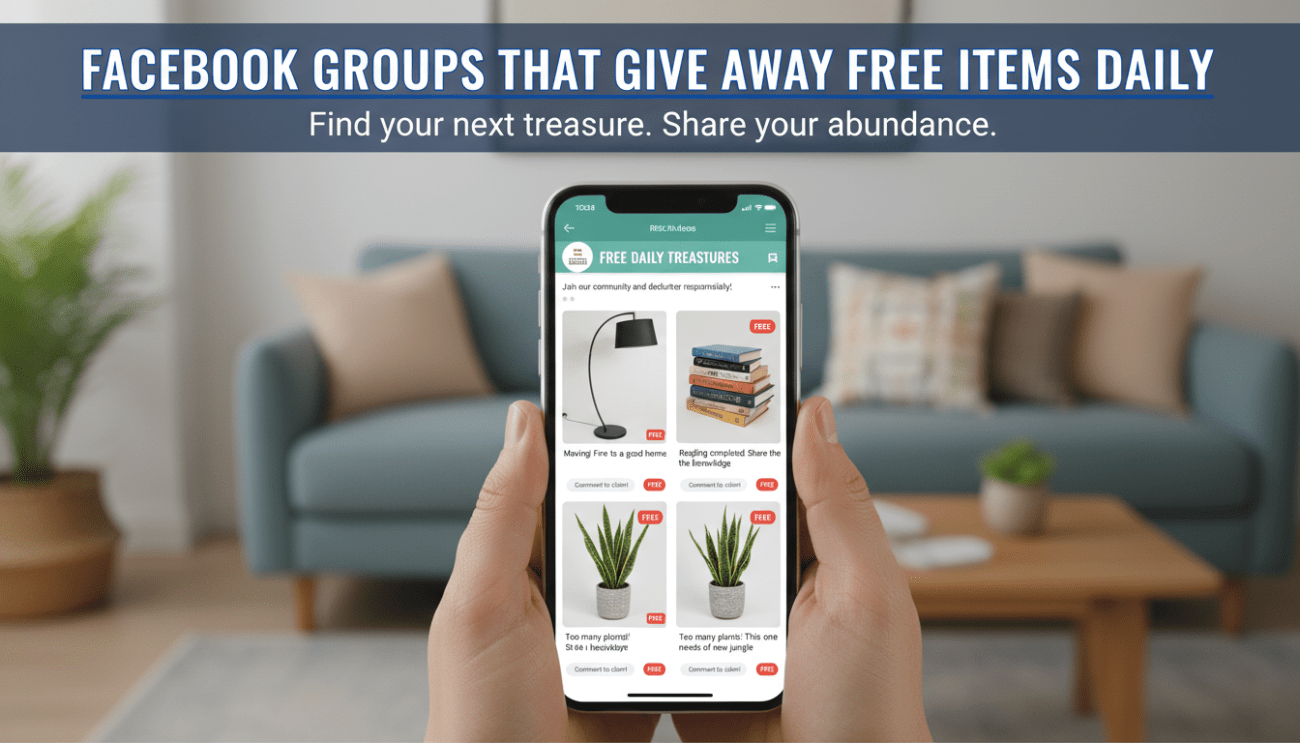
The concept of “free stuff” often conjures images of low-quality hand-me-downs or online scams. However, a vibrant, organized, and surprisingly high-quality movement is thriving on social media, offering a genuine way to save money, reduce waste, and build community. This movement is centered around hyper-local gifting groups on Facebook.
These groups, most notably the Buy Nothing Project, have transformed the way neighbors interact, creating micro-economies where the currency is not money, but gratitude and sharing. They offer a constant stream of items—from baby gear and furniture to tools and plants—all available for the price of a simple “thank you.”
This article will guide you through the world of community gifting groups, explaining the core philosophies, the practical etiquette, and the essential safety precautions you need to know. We will provide a transparent look at the real-world constraints and trade-offs involved in this rewarding, yet sometimes challenging, pursuit of free items.
Who This Is For / Not For
This guide is designed for beginners and early intermediate users who are looking for practical ways to save money, reduce their environmental footprint, and connect with their local community. If you are comfortable using Facebook and are willing to follow community rules, this is for you.
This article is not for those looking for a quick way to acquire high-value items for resale, those who are unwilling to meet neighbors for pickup, or those who require immediate, guaranteed access to specific items. We avoid hype and focus on the clear, realistic, and educational reality of the gifting economy.
The Core Philosophy: Beyond Free Stuff
The most successful free item groups are built on a philosophy that goes beyond simple transactions. They are driven by a desire to reduce consumption, keep usable items out of landfills, and foster local connection [1].
1. The Buy Nothing Project
The Buy Nothing Project is the gold standard in community gifting. It is a worldwide movement that operates through hyper-local, private Facebook groups.
- Hyper-Local Rule: You can only join the group that corresponds to your specific neighborhood or town. This ensures that the items are genuinely accessible to your immediate neighbors.
- The Core Tenets: The group is dedicated to “giving, receiving, lending, and sharing gratitude.” There is no buying, selling, or trading—everything must be gifted freely.
- The “Ask” and the “Give”: Members can post an “Ask” for something they need or a “Give” for something they want to pass on. The giver chooses who receives the item, which often leads to thoughtful selection rather than a first-come, first-served rush.
2. Freecycle and Other Local Groups
The Freecycle Network is another major player, often operating through its own website but with many local chapters using Facebook groups as their primary communication tool.
- Focus on Waste Reduction: Freecycle’s main goal is to keep usable items out of landfills. The groups are often less strict on the “hyper-local” rule than Buy Nothing groups, covering a wider geographic area.
- General “Free Stuff” Groups: Many communities have general “Free Stuff” or “Nothing for Sale” groups. While these can be great resources, they often lack the strict moderation and community focus of the Buy Nothing Project, sometimes leading to more no-shows or less-than-ideal interactions.
Trust and Transparency: The Real-World Constraints
While the concept of free items is appealing, participating in these groups involves practical trade-offs and safety considerations that must be addressed transparently.
1. The Privacy and Safety Trade-Off
The nature of community gifting requires meeting strangers, which introduces a safety and privacy constraint.
- Porch Pickups (PPU): The most common method is the Porch Pickup (PPU), where the giver leaves the item on their porch and the recipient collects it at an agreed-upon time. This is convenient, but it means you are sharing your home address with a neighbor you may not know well.
- The Constraint: To mitigate this, many experienced users recommend using a public meeting spot for larger items, or setting up a designated “PPU zone” that is visible from the street but not directly at your front door. Always trust your instincts; if a pickup feels unsafe, cancel it [2].
2. The Time and Effort Cost
Finding high-quality items is not a passive activity; it requires effort and time.
- The “Sniping” Problem: Highly desirable items (e.g., brand-new baby strollers, high-end furniture) are often claimed within minutes of being posted. You must check the group frequently and be ready to respond quickly.
- The Learning Curve: You must learn the group’s specific etiquette. In Buy Nothing groups, a simple “I want it” is often frowned upon. A thoughtful response explaining why you need the item and how you will use it is more likely to be chosen by the giver.
3. Regional Variability
The activity and quality of a group are entirely dependent on the local community.
- The Constraint: A group in a densely populated area with high turnover (e.g., a college town) will likely have a constant stream of high-quality items. A group in a sparsely populated or stable area may have less frequent posts.
- The Solution: If your local group is slow, consider joining a nearby group that covers a slightly wider area, provided the group rules allow it.
Expertise, Experience, and Trustworthiness: What the Community Says
The best way to understand the gifting economy is through the experiences of those who participate daily. This section summarizes common themes from community discussions.
Disclosure: The author of this article did not participate in the following discussions. This is a summary of community experiences to provide a broader, more trustworthy perspective.
The Frustration of “No-Shows”
The most common complaint across all free item groups is the “no-show”—a recipient who agrees to pick up an item but never arrives and stops responding to messages.
“I was giving away a perfectly good couch. The person confirmed three times, and I waited home all afternoon. They never showed up, and I had to repost the item. It’s frustrating, but you have to remember that people are busy, and there’s no money on the line to enforce the commitment. I now always have a backup person ready.” — Giver Testimonial, Local Facebook Group
This highlights a key constraint: the lack of a financial transaction means the commitment level is often lower. Givers must be prepared for this reality.
The Unexpected Wins
Conversely, the community often shares stories of incredible generosity and unexpected finds.
“I was struggling to afford a high chair for my first baby. I posted an ‘Ask’ in my Buy Nothing group, and a neighbor gifted me a top-of-the-line Stokke Tripp Trapp that was barely used. It saved me over $300. It wasn’t just the item; it was the kindness of a stranger that made the difference.” — Recipient Testimonial, Reddit r/povertyfinance
These stories underscore the core value of the movement: it is a form of mutual aid that can genuinely impact a family’s budget and well-being.
Actionable Guidance: How to Become a Successful Gifter and Receiver
Success in the free item economy is not about luck; it is about following etiquette and being prepared.
For the Receiver (The “Asker”)
- Be Specific: When you post an “Ask,” be detailed about what you need and why. Instead of “I need a desk,” try “I need a small desk (around 40 inches wide) for my child’s remote learning setup.”
- Be Thoughtful: When responding to a “Give,” write a personalized message. Explain how the item will be used. Givers often choose the person with the most compelling story, not the first person to respond.
- Be Reliable: If you commit to a pickup time, show up on time. If you need to cancel, communicate immediately. Your reputation in the group is your currency.
For the Giver (The “Gifter”)
- Post Clear Photos: Use clear, well-lit photos of the item. Include a common object (like a coin or a shoe) for scale.
- Set Clear Terms: Specify the pickup method (PPU, public meeting), the time window, and whether you will choose the recipient randomly or based on their story.
- Have a Backup: Always choose a primary recipient and a backup recipient in case of a no-show.
Conclusion: The True Value of Free
The question is not whether you can find free items on Facebook, but whether you are willing to engage with the community and accept the trade-offs involved.
The true value of these groups is not the monetary savings, but the shift in perspective. They teach us that items have a life beyond their initial purchase, and that a strong community can be built on the simple, powerful act of sharing. By participating responsibly, you are not just getting free stuff; you are investing in a more sustainable, connected, and generous neighborhood.
References
[1] CNBC. (2021). Groups like Buy Nothing and Freecycle bolster budgets and community. (Discusses the goals of waste reduction and community building).
[2] The Penny Hoarder. (2025). Get Free Stuff Online by Joining a Local Buy Nothing Group. (Provides practical advice on finding groups and safety).
[3] Buy Nothing Project. Official Website. [URL: http://buynothingproject.org/]
[4] Freecycle Network. Official Website. [URL: https://www.freecycle.org]
[5] Facebook. Official Website. [URL: https://www.facebook.com]
[6] Stokke. Stokke Tripp Trapp High Chair. [URL: https://www.stokke.com/USA/en-us/high-chairs/tripp-trapp/TT01.html]
[7] Reddit r/povertyfinance. Community Testimonials. (Summarized from various threads discussing financial impact of gifting groups).
Deep Dive: The Rules of Engagement and the “Gift Economy”
To truly succeed in these groups, one must understand the specific rules and the broader concept of the gift economy that governs them. This is not just about getting free items; it is about participating in a different kind of social contract.
Understanding the “Gift Economy”
A gift economy is a system where goods and services are given without an explicit agreement for immediate or future rewards. In the context of Facebook groups, this means:
- No Strings Attached: When you give an item, you are not expecting anything in return—not even a trade.
- Building Social Capital: While there is no financial reward, participants build “social capital”—a sense of trust and mutual obligation within the community.
- The Power of Gratitude: In many groups, “Gratitude Posts” are a core requirement. These are posts where recipients share a photo of the item in its new home and thank the giver. This reinforces the positive cycle of the group.
Navigating Group Rules: A Practical Guide
Every group has its own set of rules, and violating them can lead to being removed. Here are the most common rules you will encounter:
| Rule Type | Common Requirement | Why It Matters |
|---|---|---|
| No Reselling | Items received for free must not be sold for profit. | Prevents “flippers” from taking items away from neighbors who genuinely need them. |
| No Begging | Avoid posting constant, desperate “Asks” for high-value items. | Maintains the positive, community-focused tone of the group. |
| No “First-Come, First-Served” | Givers are encouraged to let an item “simmer” for a few hours before choosing a recipient. | Ensures that everyone has a fair chance to see the post, not just those who are constantly online. |
| Respect the Borders | You must live within the specific geographic area defined by the group. | Keeps the community hyper-local and manageable for pickups. |
The Safety and Privacy Paradox: A Closer Look
The most significant real-world constraint of community gifting is the tension between the desire for community and the need for personal safety and privacy.
The “Porch Pickup” (PPU) Strategy
The PPU is the backbone of the gifting economy, but it requires a high degree of trust.
- The Risk: You are sharing your home address with a stranger. While the hyper-local nature of the group reduces this risk, it does not eliminate it.
- The Mitigation: Many users set up a “pickup station” that is visible from the street but not directly at their front door. This could be a designated box on the driveway or a specific spot on the porch.
- The “Buddy System”: If you are picking up an item from a neighbor’s home, especially for a larger item that requires going inside, always bring a friend or let someone know where you are going and when you expect to be back.
The Data Privacy Constraint
By participating in these groups, you are also sharing information with Facebook.
- The Constraint: Your participation in these groups—what you ask for, what you give, and who you interact with—is data that Facebook uses to build your consumer profile.
- The Solution: Review your Facebook privacy settings and limit the amount of personal information you share in your public profile. Remember that while the group is “private,” your interactions within it are still part of the platform’s data ecosystem.
Final Thoughts: The Future of Community Gifting
The rise of Facebook gifting groups is a testament to the enduring human desire for connection and the practical need for sustainability. As we move toward a more circular economy, these groups will only become more important.
The true value of a “free” item is not its price tag, but the story behind it and the connection it creates between neighbors. By participating with transparency, respect, and a commitment to the community, you are not just saving money; you are helping to build a more resilient and generous world. The next time you have something you no longer need, don’t throw it away—gift it to a neighbor. You might be surprised at the value you get in return.