Quick summary: “Free shipping” is usually a strategy to raise average order value. This guide explains how thresholds work, when they are worth chasing, and how to avoid overbuying just to save on shipping.
Who this is for
- For: Anyone trying to reduce shipping costs without getting upsold into unnecessary purchases.
- Not for: People who do not want to compare totals across retailers.
Key takeaways
- Compare total cost (items + shipping + returns) before chasing a threshold.
- Return policies can erase “free shipping” savings.
- Membership shipping can be worth it only when you actually use it.
Common pitfalls to avoid
- Overbuying low-value items just to hit a threshold.
- Ignoring restocking fees and return shipping costs.
- Accidentally enrolling in subscription/membership shipping.
Related guides
Full guide
The sections below include the full, detailed walkthrough. Skim the summary above, then use the headings to jump to what you need.
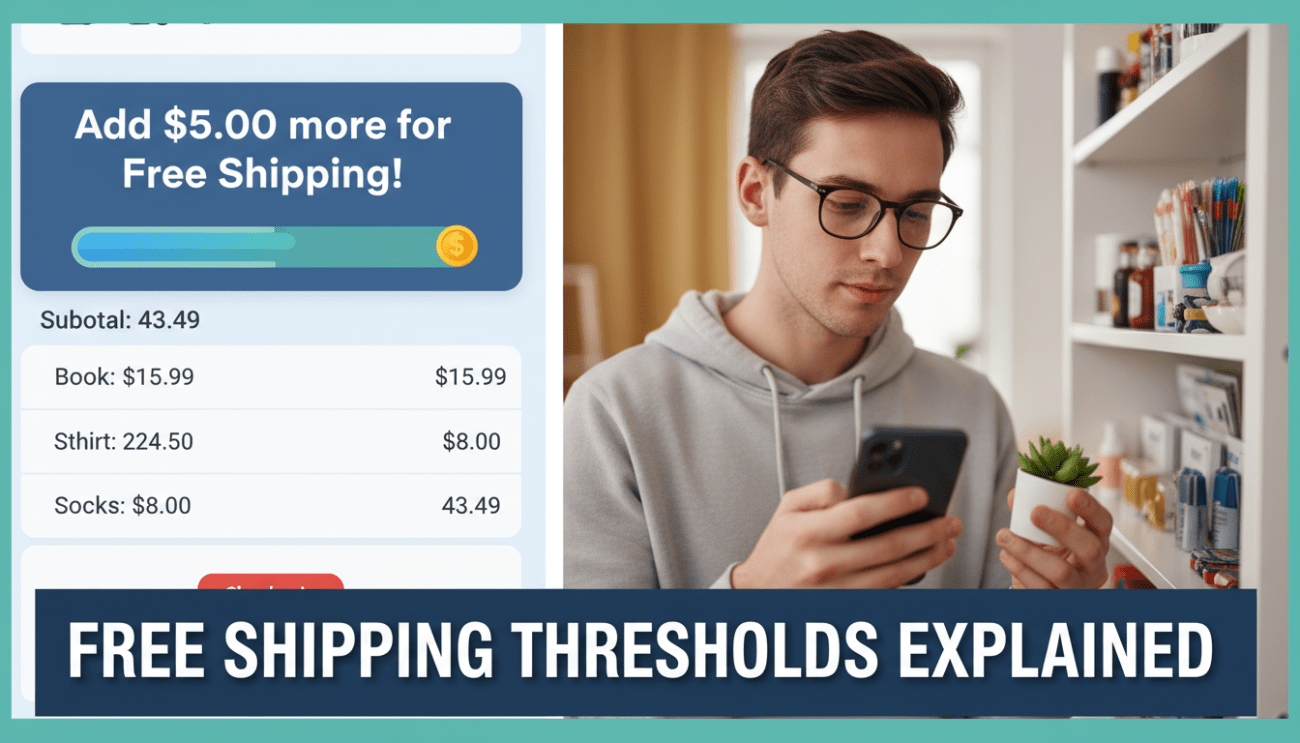
We have all been there. You have a $28 item in your cart, and just as you are about to check out, a message pops up: “Add $7 more to qualify for FREE shipping!”
Suddenly, you find yourself browsing for a pair of socks or a pack of batteries you didn’t know you needed, just to avoid a $6.99 shipping fee. This is the “Free Shipping Threshold” in action. It is one of the most effective psychological tools in the e-commerce industry, designed to increase the amount of money you spend in a single transaction.
This guide will break down how these thresholds work, why retailers use them, and how you can navigate them like a pro without falling into the trap of overspending.
Who This Guide Is For (and Who It’s Not)
This guide is for:
- Beginners who want to understand why shipping costs vary and how to avoid them.
- Early intermediates looking for “hacks” to meet thresholds without buying useless items.
- Budget-conscious shoppers who want to maximize the value of every dollar spent online.
This guide is NOT for:
- People who need items “yesterday.” Free shipping is almost always the slowest shipping method.
- High-volume shoppers who already pay for memberships like Amazon Prime or Walmart+.
- Users looking for “illegal” hacks. We only discuss legitimate, retailer-approved methods.
The Reality of “Free”: Understanding the Trade-offs
Retailers don’t offer free shipping because they are generous; they do it because it is profitable. Shipping an item costs money—for the box, the labor, and the carrier (like UPS or FedEx). When a retailer offers “free” shipping, they are absorbing that cost.
- Increased Average Order Value (AOV): By setting a threshold (e.g., $35), retailers encourage you to add more items to your cart. According to Digital Commerce 360, over 50% of shoppers will add items to their cart specifically to meet a free shipping minimum.
- Reduced Cart Abandonment: High shipping fees are the #1 reason people abandon their online shopping carts. A threshold provides a clear path for the customer to “earn” free shipping, which feels like a reward.
- The “Free” Effect: Psychologically, the word “free” is significantly more powerful than “discounted.” Most people would rather spend $40 on products and get free shipping than spend $30 on products and pay $5 for shipping, even though the total cost is lower in the second scenario.
“Free shipping isn’t a gift; it’s a trade. You give the retailer a larger order, and they give you the shipping for ‘free’.” — A common insight from e-commerce analysts.
1. Major Retailer Thresholds in 2026
While thresholds change, the “Big Three” in the U.S. have remained relatively consistent over the last few years.
| Retailer | Standard Threshold | Membership Option |
|---|---|---|
| Amazon | $35 (for non-Prime) | Amazon Prime ($0 minimum) |
| Walmart | $35 | Walmart+ ($0 minimum) |
| Target | $35 | Target Circle 360 ($0 minimum) |
| Best Buy | $35 | My Best Buy Plus ($0 minimum) |
Amazon
For those without a Prime membership, Amazon typically requires a $35 minimum order of “eligible” items to qualify for free shipping.
- The Catch: Not every item on Amazon is eligible. Look for the “FREE Shipping on orders over $35” label next to the price.
- Pro Tip: If you are just under the limit, look for “Filler Items.” There are websites dedicated to finding items that cost exactly the amount you need to hit the threshold.
Walmart
Walmart’s $35 threshold is one of the most straightforward. Most items shipped by Walmart (not third-party sellers) count toward this total.
- The Advantage: Walmart often offers “NextDay” or “Two-Day” shipping on these orders, making it faster than Amazon’s non-Prime shipping.
2. The “Hidden” Free Shipping Perks: Credit Cards and Partners
You might already have free shipping access without knowing it. In 2026, many financial institutions and third-party services partner with retailers to eliminate thresholds.
ShopRunner
ShopRunner is a service that provides free 2-day shipping and free returns at over 100 online stores (including Saks Fifth Avenue, Under Armour, and Neiman Marcus).
- The Hack: While it normally costs $79/year, many American Express, Chase, and Mastercard holders get a free membership as a card perk. Check your credit card’s “Benefits” portal to see if you can activate it.
Sephora and Ulta
Beauty retailers have some of the most loyal customers, and they reward that loyalty with shipping perks.
- Sephora: As of 2026, Sephora offers free shipping on all orders for members of their “Beauty Insider” program. It is free to join, meaning there is effectively no threshold for Sephora shoppers.
- Ulta: Ulta typically has a $35 threshold, but “Platinum” and “Diamond” members (who spend a certain amount annually) often get free shipping on smaller orders or during special “21 Days of Beauty” events.
3. How to Meet the Threshold Without “Wasting” Money
The biggest mistake shoppers make is buying something they will never use just to hit a threshold. Instead, use these “Smart Filler” strategies:
- The “Pantry Stock” Method: Instead of buying a random gadget, add a non-perishable item you know you will eventually use, such as toothpaste, laundry detergent, or a box of pasta.
- The “Gift Closet” Strategy: Buy a small gift (like a $10 toy or a nice candle) that you can save for an upcoming birthday or holiday.
- The “Pre-Order” Hack: Some retailers allow you to add a pre-order item (like a video game or book) to your cart to hit the threshold. You can often cancel the pre-order later, though some retailers have caught on to this and may charge you shipping retroactively. Use this with caution.
- The “Ship to Store” Option: If you live near a physical location for retailers like Target or Best Buy, you can often choose “Store Pickup” for free, regardless of the order total.
4. International Shipping: The Threshold Challenge
If you are shopping from outside the U.S., thresholds are often much higher ($100-$150) or non-existent.
- Package Forwarding: Services like Shipito or MyUS give you a U.S. address. You can ship multiple small orders to their warehouse (often using the U.S. free shipping thresholds) and then pay one fee to “consolidate” them into a single box for international delivery.
- The “Landed Cost” Trap: Be careful—even if shipping is free, you may still be responsible for import duties and taxes when the package arrives in your country. Some retailers, like ASOS, include these in the price, while others do not.
5. The Hidden Costs of Free Shipping
While the shipping fee is $0, there are other “costs” you should be aware of:
- Slower Delivery: Free shipping is almost always the lowest priority for the warehouse and the carrier. If you need an item for a specific event, “free” might be too slow.
- Privacy Trade-offs: To get free shipping, many retailers require you to create an account and join their “Loyalty Program.” This allows them to track your purchases and send you targeted marketing emails.
- Return Shipping: Just because the shipping to you was free doesn’t mean the shipping back to the retailer will be. Always check the return policy. Retailers like Zappos are famous for free shipping both ways, but they are the exception, not the rule.
6. Membership Programs: Are They Worth It?
In 2026, almost every major retailer has a paid membership program that offers “Free Shipping with No Minimum.”
- Amazon Prime: ~$139/year. Worth it if you order more than 20 times a year or use Prime Video.
- Walmart+: ~$98/year. Worth it if you do your grocery shopping through Walmart.
- Target Circle 360: ~$99/year. Worth it for the same-day delivery via Shipt.
The Math: If the average shipping fee is $7, you need to place about 14-20 orders a year to “break even” on a membership. If you shop less than once a month, you are better off sticking to the thresholds.
Summary Table: Threshold Strategies
| Strategy | Best For | Pros | Cons |
|---|---|---|---|
| Filler Items | Small gaps ($1-$5) | Gets you the free shipping. | Can lead to clutter. |
| Store Pickup | Local shoppers | $0 minimum, often same-day. | Requires a trip to the store. |
| Memberships | Frequent shoppers | No thresholds, fast shipping. | High annual cost. |
| Pantry Loading | Large gaps ($10+) | No wasted money. | Requires storage space. |
| Credit Card Perks | Amex/Chase holders | Free ShopRunner access. | Requires specific cards. |
Real-World Constraints: Regional Variability
Shipping is a logistical nightmare, and geography plays a huge role.
- Rural Areas: If you live in a remote area, some “free shipping” offers may not apply, or the threshold might be higher.
- Alaska and Hawaii: Most U.S. retailers exclude these states from free shipping offers entirely due to the high cost of air freight.
- Attribution: Logistics experts at Ryder note that as fuel prices and labor costs rise, more retailers are quietly raising their thresholds from $25 to $35 or even $50.
User Testimonials: Lessons from the Community
Note: The author of this article did not participate in these experiences; these are summaries of documented community discussions from platforms like Reddit, Quora, and consumer advocacy forums.
- The “Filler” Success: “I needed a $32 coffee maker from Walmart. Shipping was $6.99. I added a $3.50 box of trash bags that I was going to buy next week anyway. I saved $3.49 and got the bags ‘for free’ essentially.”
- The “Return” Trap: “I bought two sizes of a dress to hit a $75 free shipping limit, planning to return one. I didn’t realize the store charged $8 for return shipping labels. I ended up paying more than if I had just paid for the original shipping.”
- The “Store Pickup” Fan: “I use Target’s ‘Drive Up’ for everything. I can buy a single $2 toothbrush and they bring it to my car for free. No thresholds, no shipping fees, and I don’t even have to unbuckle my kids.”
- The “Sephora” Hack: “I used to wait until I had $50 of stuff to order from Sephora. Now that they have free shipping for all members, I just buy things as I run out. It stops me from ‘panic buying’ extra stuff just to hit a limit.”
Final Thoughts
Free shipping thresholds are a game. The retailers set the rules to make you spend more, but if you are disciplined, you can use those same rules to your advantage.
The most important takeaway: Never spend $10 on something you don’t want just to save $7 on shipping. That is a net loss of $3. If you can’t find a “Smart Filler” that you actually need, it is often cheaper to just pay the shipping fee and move on with your day.
Stay savvy, check your cart twice, and happy shopping!
Disclaimer: This article is for informational purposes only. The author is not affiliated with the companies mentioned. While we strive for accuracy, shipping policies change frequently. Always verify the terms on the retailer’s official website before completing your purchase.
FAQ
Is it ever worth adding items to hit a threshold?
Only when the extra items are genuinely useful and the return policy is clear. Otherwise you are paying for “free shipping” with clutter.
Why trust this guide?
AllFreeStuff.com is editorial-first: we verify sign-up flows, read the fine print, and update guides when offers, limits, or policies change. We do not publish bulk scraped lists, and we remove entries that become misleading or no longer deliver value.
Sources

Jordan Lee is a seasoned retail analyst at AllFreeStuff.com with a focus on discount lifecycles, coupon stackability, and household procurement strategy. With over eight years of experience tracking the pricing algorithms of major US retailers, Jordan specializes in helping consumers identify the “Optimal Buy Window” for everything from household essentials to high-end electronics.
Why Trust Jordan’s Insights?
- Retail Cycle Tracking: Jordan maintains a proprietary database of annual retail discount trends, allowing AllFreeStuff.com readers to predict when coupon codes and clearance events will peak.
- Vetted Savings: Unlike generic deal-hunters, Jordan focuses on “Total Value”—calculating shipping costs, data privacy trade-offs, and long-term subscription ROI before recommending an offer.
- Budget Advocacy: Jordan’s work has been featured in numerous personal finance discussions, focusing on the “Sustainable Savings” movement—finding free items and deals that reduce household waste and environmental impact.
Prior to joining the AllFreeStuff.com editorial team, Jordan worked as a procurement consultant, where they gained a “behind-the-scenes” look at how retailers use promo codes to manage inventory. This insider knowledge now serves the public, providing a transparent look at which “Free Gifts” are genuine rewards and which are simply marketing lures.