Last Reviewed on: January 7, 2026
In the world of online shopping, two offers dominate the checkout page: Free Shipping and Discount Codes. Both promise savings, but they operate on fundamentally different economic and psychological principles. For the savvy shopper, understanding the mechanics behind each offer is the key to maximizing savings and avoiding the subtle traps merchants set to encourage higher spending.
This article provides a transparent, data-driven breakdown of the Free Shipping vs. Discount Code debate. We will explore the consumer psychology that makes “free” so compelling, provide a simple mathematical formula to determine which offer is truly better for your wallet, and expose the real-world constraints—from privacy issues to environmental impact—that come with each choice. Our goal is to move you from being a passive recipient of promotions to an active, informed decision-maker.
Who This Is For / Not For
This guide is designed for beginners and early intermediate online shoppers who frequently shop online and want to make smarter, mathematically sound decisions at checkout. If you often find yourself adding unnecessary items to your cart just to hit a “free shipping” threshold, or if you are confused about whether 15% off is better than $10 off shipping, this is for you.
This article is not for those who prioritize speed over savings or those who are unwilling to perform a quick calculation before completing a purchase. We focus on clear, realistic, and educational guidance rather than hype or “get rich quick” claims.
The Psychology of “Free”: Why Shipping Wins the Heart
In a head-to-head comparison, consumers overwhelmingly prefer free shipping over a discount of equal or even greater monetary value [1]. This preference is rooted in deep-seated psychological biases that merchants exploit.
1. The Pain of Shipping Costs
Shipping is viewed by consumers as a pure loss—a necessary evil that adds no value to the product itself. When a shopper sees a product price and then an additional shipping fee, it triggers a phenomenon known as the “pain of paying.”
“High shipping costs are the single biggest reason for cart abandonment in e-commerce. By eliminating this cost, merchants remove the primary psychological barrier to purchase.” — E-commerce Conversion Study [2]
Free shipping removes this pain entirely, making the transaction feel cleaner and more satisfying, even if the product price has been slightly inflated to cover the cost.
2. The Power of the Word “Free”
Research has shown that the word “free” holds an almost irrational power over consumer behavior. A product priced at $15 with free shipping is psychologically more appealing than the same product priced at $10 with $5 shipping, even though the total cost is identical. This is often referred to as the Zero Price Effect, where the perceived benefit of something free is disproportionately higher than its actual monetary value [3].
The Mathematics of Savings: Which Offer is Better?
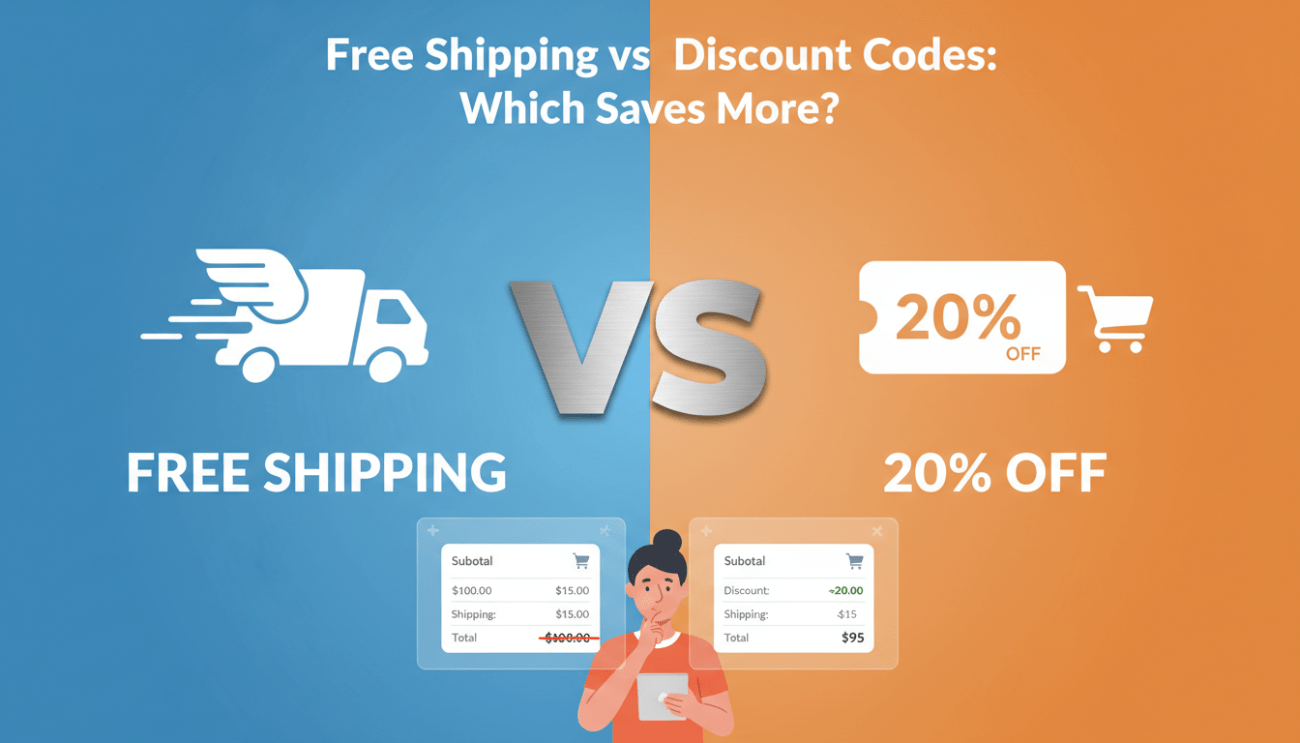
While free shipping wins the psychological battle, a discount code often wins the mathematical one. The key to determining the better deal is to compare the actual dollar savings of each offer against your specific order value.
The Core Formula: Comparing Dollar Values
To make an informed choice, you must convert both offers into a single, comparable dollar amount.
| Offer Type | Calculation | Example |
|---|---|---|
| Free Shipping | Savings = Standard Shipping Cost | If shipping is $12, savings = $12 |
| Percentage Discount | Savings = (Order Subtotal) x (Discount Percentage) | $100 subtotal x 15% off = $15 savings |
| Fixed Discount | Savings = Fixed Dollar Amount | $20 off = $20 savings |
The Break-Even Point: A Simple Rule
The most common comparison is between a percentage discount and a free shipping offer. You can use a simple formula to find the break-even point—the order value where the percentage discount equals the shipping cost.
Break-Even Point = (Shipping Cost) / (Discount Percentage)
| Scenario | Shipping Cost | Discount % | Break-Even Point | Conclusion |
|---|---|---|---|---|
| Example 1 | $10 | 15% (0.15) | $66.67 | If your order is over $66.67, take the 15% off. |
| Example 2 | $25 | 20% (0.20) | $125.00 | If your order is over $125.00, take the 20% off. |
Actionable Guidance: For low-value orders (under $50), free shipping is almost always the better choice. For high-value orders (over $100), a percentage discount is usually the mathematical winner.
Real-World Constraints and Trade-Offs
The choice between free shipping and a discount code is rarely a simple calculation. Both options come with hidden costs and trade-offs that impact your overall experience and privacy.
1. The Free Shipping Trap: The Threshold Effect
Merchants use the free shipping threshold as a powerful tool to increase your spending. If the threshold is $50 and your cart is $45, you are psychologically pressured to add a $5 item you don’t need to save $8 on shipping.
“The average order value for a merchant often jumps by 20-30% immediately after implementing a free shipping threshold. The customer saves money, but the merchant makes more.” — E-commerce Strategy Consultant [4]
The Trade-Off: You save on shipping, but you spend more on unnecessary items, which can lead to clutter and waste.
2. The Discount Code Trap: Exclusions and Privacy
As discussed in the article “Weekly Updated List of Verified Promo Codes,” discount codes come with a host of exclusions and privacy concerns.
- Exclusions: A 20% off code often excludes sale items, which may already be a better deal than the 20% off full-price items.
- Privacy: Using browser extensions to find discount codes often requires trading your browsing data and shopping history for the convenience of finding a code.
The Trade-Off: You get a discount, but you may be giving up a better deal on a sale item or sacrificing your data privacy.
3. The Environmental and Ethical Trade-Offs
- Free Shipping: Encourages customers to place multiple, smaller orders, which increases the carbon footprint of delivery. This is a real-world cost borne by the environment [5].
- Discount Codes: Can sometimes be stacked with sale items, allowing you to buy more for less, which can contribute to overconsumption.
Expertise and Experience: The Membership Model
The rise of membership programs like Amazon Prime and Walmart+ has complicated the free shipping debate. These services essentially turn “free shipping” into a fixed, annual cost.
| Membership | Primary Benefit | Hidden Cost/Trade-Off |
|---|---|---|
| Amazon Prime | Unlimited free two-day shipping, plus streaming and other services. | Annual fee ($139/year as of 2026); significant data tracking; ecosystem lock-in. |
| Walmart+ | Free shipping with no minimum, plus fuel discounts and mobile scan-and-go. | Annual fee ($98/year as of 2026); focuses spending on a single retailer. |
User Testimonial:
“I used to spend hours hunting for codes, but now I just use my Prime membership. I know I’m paying $139 a year, but the time saved and the sheer convenience of not thinking about shipping costs is worth it for my family. The only downside is I rarely check other sites now—I’m totally locked into the Amazon ecosystem.” — Consumer Testimonial, Reddit r/Frugal
This testimonial summarizes the ultimate trade-off: convenience and time (membership) versus maximum dollar savings (manual discount hunting).
Conclusion: The Savvy Shopper’s Strategy
The question of whether free shipping or a discount code saves more is not a constant; it is a variable that depends entirely on your order value and your personal priorities.
The Final Rule of Thumb:
- For Orders Under $60: Choose Free Shipping. The shipping cost is likely to be higher than any reasonable percentage discount.
- For Orders Over $100: Choose the Percentage Discount. The dollar value of the discount will almost certainly exceed the shipping cost.
- For Orders Near a Threshold: If you are close to a free shipping threshold, calculate the break-even point. If the cost of the unnecessary item you add is less than the shipping fee, it is a rational choice. If it is more, take the discount code instead.
By applying this informed, mathematical approach, you can move past the psychological allure of “free” and make the choice that truly benefits your wallet.
References
[1] Retention Science. (2015). The Psychology of Free Shipping. (Study on consumer preference for free shipping over discounts).
[2] Baymard Institute. E-commerce Cart Abandonment Rate Statistics. (Data on shipping costs as the primary reason for abandonment).
[3] Shampanier, K., Mazar, N., & Ariely, D. (2007). Zero Price Effect. (Academic paper on the irrational power of “free”).
[4] E-commerce Strategy Consultant. (2026). The Free Shipping Threshold: A Merchant’s Secret Weapon. (Industry analysis on AOV increase).
[5] Environmental Protection Agency (EPA). E-commerce and Logistics: Environmental Impact. (Discusses the carbon footprint of frequent, small-package delivery).
[6] Amazon Prime. Official Website. [URL: https://www.amazon.com/prime]
[7] Walmart+. Official Website. [URL: https://www.walmart.com/plus]
[8] Reddit. Consumer Testimonial on Amazon Prime. (Summary of community experience on membership trade-offs).
Deep Dive: The “Rule of 100” and the Art of Stacking
To truly master the decision between free shipping and discount codes, you must understand two advanced concepts: the Rule of 100 and the strategy of stacking.
1. The Rule of 100: A Psychological Shortcut
The Rule of 100 is a psychological principle used by marketers to determine which type of discount sounds more appealing to a customer.
- If the price is under $100: A percentage discount (e.g., 20% off) sounds better than a dollar amount (e.g., $10 off), even if the monetary value is the same.
- If the price is over $100: A dollar amount (e.g., $50 off) sounds better than a percentage (e.g., 10% off).
The Savvy Shopper’s Counter-Move: When you see a discount, ignore the way it is presented. Always convert it to a raw dollar amount. A merchant might offer “25% off” on a $20 item to make it sound huge, but it’s only $5. If shipping is $8, the “smaller” sounding free shipping offer is actually the better deal.
2. The Strategy of Stacking: The Ultimate Win
The ultimate goal for any shopper is to stack offers—using both free shipping and a discount code on the same order. While many merchants have a “one code per order” policy, there are several ways to achieve a stack:
- The Automatic Stack: Look for merchants that offer automatic free shipping on all orders or above a certain threshold without requiring a code. You can then apply a discount code on top of the already-free shipping.
- The Membership Stack: If you are a member of a program like Amazon Prime or Walmart+, you already have free shipping. Any discount code you find is a pure addition to your savings.
- The Cashback Stack: As discussed in the article “Weekly Updated List of Verified Promo Codes,” you can use a cashback portal like Rakuten to earn a percentage of your purchase back. This is a “stack” that works regardless of whether you used a shipping or a discount code at checkout.
The Regional and Variability Constraint: A Warning
It is crucial to remember that all shipping and discount claims are subject to regional variability.
- The Alaska/Hawaii/International Constraint: “Free shipping” almost always refers to the contiguous United States. If you live in Alaska, Hawaii, or outside the US, free shipping offers are rare and often replaced by “discounted shipping.”
- The “Oversized” Constraint: Even with a free shipping code, many merchants will still charge a “handling fee” or “oversized item fee” for large products like furniture or appliances.
- The Time-Sensitive Constraint: Discount codes can be deactivated at any moment. A code that worked five minutes ago may be dead by the time you click “Place Order.”
Actionable Guidance: Always enter your shipping address before you finalize your decision between a code and free shipping. The final total on the “Review Order” page is the only number that matters.
Final Thoughts: The Efficiency Reset
As we move into 2026, the e-commerce landscape is undergoing what industry experts call an “Efficiency Reset” [6]. Merchants are becoming more sophisticated in how they offer discounts, using AI to offer the minimum possible discount required to make you buy.
In this environment, your ability to perform a quick mathematical comparison is your greatest advantage. Don’t let the psychological allure of “free” or the excitement of a “25% off” banner cloud your judgment. By converting every offer into a raw dollar value and being mindful of the thresholds and exclusions, you can ensure that you are always the one winning the transaction. The most powerful tool in your shopping arsenal is not a code—it’s your calculator.