Last reviewed on: January 7, 2026. Game monetization policies, data privacy regulations, and platform rules are subject to change and may vary by region.
The allure of a “free” game is undeniable. Whether it’s a high-octane shooter like Valorant or a relaxing mobile puzzle, the ability to jump into a world of entertainment without spending a dime is a hallmark of modern gaming. However, as the old saying goes, “if you aren’t paying for the product, you are the product.”
In the gaming industry, the “Free-to-Play” (F2P) model has become a multi-billion dollar powerhouse. But behind the vibrant graphics and addictive loops lies a complex web of hidden costs. These aren’t just financial; they involve your time, your personal data, and even your psychological well-being. This article explores the reality of F2P gaming, helping you navigate these digital worlds with your eyes wide open.
Who This Is For / Not For
This guide is for:
- Beginner and intermediate gamers who want to understand how “free” games actually make money.
- Parents looking to guide their children through the world of in-app purchases and online privacy.
- Casual players who feel like they are spending more time or money than they intended.
- Anyone interested in the intersection of technology, psychology, and consumer rights.
This guide is not for:
- Professional “whales” (high-spending players) who are fully aware of and comfortable with their spending habits.
- Game developers looking for technical implementation details of monetization systems.
- Hardcore competitive players who prioritize “meta” advantages over cost-benefit analysis.
1. The Financial Illusion: When “Micro” Becomes Massive
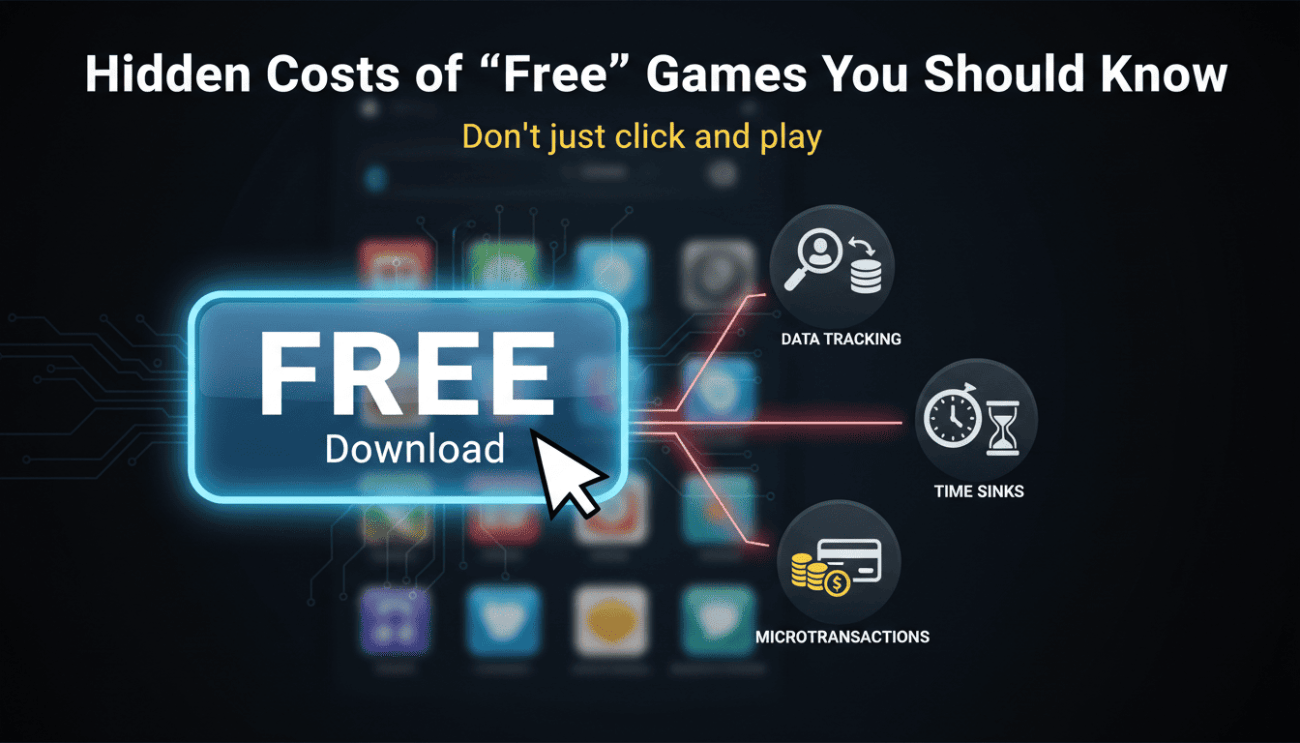
The most obvious hidden cost is the financial one. F2P games often use “microtransactions”—small purchases typically ranging from $0.99 to $20. Individually, these feel insignificant. However, they are designed to be “invisible” expenses that aggregate over time.
The “Invisible” Spending Trap
Many games use a secondary currency (like “Gems,” “V-Bucks,” or “Points”) to distance the player from the reality of spending real money. When you click a button to spend 500 “Coins,” it doesn’t trigger the same psychological “pain of paying” as swiping a credit card for $5.00.
Community Experience: A user on Reddit recently shared their shock after auditing their gaming finances. Despite considering themselves a “Free to Play” player, they discovered they had spent $1,400 in a single year on small, “invisible” purchases like skins and battle passes [1].
Gacha and Loot Boxes
Some games take this further with “Gacha” or “Loot Box” mechanics. These are essentially digital gambling. You pay for a chance to win a rare item. According to a study on deceptive design, these mechanics often use “variable ratio reinforcement”—the same psychological principle that makes slot machines addictive [2]. You never know when the “big win” is coming, which keeps you pulling the lever.
2. The Time Tax: Grinding and FOMO
If you aren’t paying with money, you are almost certainly paying with time. F2P games are designed to maximize “player retention”—the amount of time you spend in the app.
The “Grind” vs. The “Skip”
Many games create artificial barriers to progress, often called “the grind.” To unlock a new character or level up, you might need to perform repetitive tasks for dozens of hours. Conveniently, the game will offer a “time-saver” or “boost” for a small fee. This creates a “pay-to-progress” model where your time is literally being sold back to you.
FOMO (Fear Of Missing Out)
Daily login bonuses, limited-time events, and “Battle Passes” are all tools used to trigger FOMO. If you don’t play today, you might miss out on a unique reward forever. This turns a hobby into a chore, requiring a daily commitment to stay “current” with the game’s community.
3. The Privacy Price: You Are the Data
In the mobile gaming world, your personal data is a highly valuable currency. When you accept the terms and conditions of a free game, you are often granting permission for extensive data collection.
What Data is Collected?
According to privacy experts at Usercentrics, free games often collect:
- Device Identifiers: Unique IDs that allow advertisers to track you across different apps.
- Location Data: Your general or even precise GPS location.
- Behavioral Analytics: How long you play, what you click on, and where you get frustrated [3].
Inferred Data: Predicting Your Behavior
The most valuable data isn’t just what you do, but what the game can infer about you. By analyzing your play patterns, developers can predict if you are likely to spend money or if you are about to quit the game. This “inferred data” is used to serve you targeted ads or even adjust the game’s difficulty to keep you engaged (and spending) longer.
4. Psychological Mechanics: The “Dark Patterns”
Game developers often employ “dark patterns”—design choices that trick users into doing things they didn’t intend to do. These are not accidental; they are carefully crafted to exploit human psychology.
Skinner Box Mechanics
Named after psychologist B.F. Skinner, these mechanics involve rewarding repetitive actions with small, unpredictable prizes. This creates a dopamine loop that can make the game feel “addictive.” You aren’t necessarily having fun; you are just waiting for the next hit of dopamine from a “Level Up” screen or a rare drop.
Deceptive Design: A Deeper Dive
Dark patterns are not just annoying; they are a form of architectural manipulation. Common deceptive designs in F2P games include:
- Artificial Scarcity and Urgency: Timers that count down to pressure you into a purchase. “Only 2 hours left for this 80% discount!” creates a false sense of urgency that bypasses rational decision-making.
- Social Pressure and “The Joneses” Effect: Showing you the high-tier gear of other players in loading screens or social hubs to make you feel inadequate. Some games even match low-level players against high-level “whales” specifically to demonstrate the power of paid items.
- Complex Currencies (The “Obfuscation” Pattern): Using multiple types of currency (e.g., Gold, Gems, Shards, and Energy) to make it nearly impossible to calculate the real-world cost of an item. By the time you’ve converted USD to Gems, and Gems to Shards, your brain has lost track of the actual value [4].
- The “Sunk Cost” Trap: Giving you a “free” gift that requires a small payment to actually use. For example, a “Free Legendary Chest” that requires a $0.99 key to open. Once you have the chest, you feel like you’ve already “earned” it, making the $0.99 feel like a minor hurdle rather than a new purchase.
Vulnerable Populations: Children and the Elderly
The hidden costs of free games are particularly predatory when it comes to those who may not fully grasp the mechanics of digital monetization.
- Children: Younger players often lack the impulse control or financial literacy to resist the “dopamine loops” mentioned earlier. The “bright lights and big sounds” of a successful Gacha pull are designed to be as stimulating as possible.
- The Elderly: As more seniors turn to mobile games for cognitive stimulation or social connection, they become targets for “ad-heavy” games that may collect sensitive health or financial data under the guise of “free” entertainment.
5. The Privacy Price: You Are the Data (Expanded)
In the mobile gaming world, your personal data is a highly valuable currency. When you accept the terms and conditions of a free game, you are often granting permission for extensive data collection that goes far beyond what is necessary for the game to function.
The Data Broker Ecosystem
According to privacy experts at Usercentrics, free games often collect device identifiers, location data, and behavioral analytics [3]. But where does this data go? Often, it is sold to “Data Brokers”—companies that aggregate information from thousands of sources to build a “digital twin” of you. This profile can include your political leanings, your health concerns, and your likelihood of defaulting on a loan.
The “Surveillance” of Play
A recent study titled Surveilling the Gamers highlighted that modern games collect and analyze player behavior in ways comparable to social media giants like Meta or TikTok. This isn’t just about showing you better ads; it’s about building a psychological profile that can be used to manipulate your behavior both inside and outside the game.
6. The Future of Free-to-Play: AI and Beyond
As we move further into 2026, the F2P model is evolving. Artificial Intelligence (AI) is now being used to create “Dynamic Monetization.”
- Personalized Pricing: AI can analyze your spending habits and adjust the price of items in real-time. If the system knows you are a “whale,” it might show you a $99 bundle. If it knows you are price-sensitive, it might offer you the same items for $9.99.
- AI-Driven Retention: AI can predict exactly when you are about to get bored and trigger a “random” event or reward to keep you in the game for just five more minutes.
7. Community Perspectives: Real Stories
To understand the human impact of these systems, we can look at the experiences shared in gaming communities.
Disclosure: The following is a summary of community experiences from platforms like Reddit and gaming forums. The author of this article did not participate in these discussions.
- The “Support” Justification: Many players feel that if they enjoy a free game, they “owe” it to the developers to spend money. While supporting creators is positive, this feeling is often intentionally cultivated by the game’s design to lower financial inhibitions [5].
- The Opportunity Cost: Members of the r/StopGaming community often discuss the “hidden cost” of growth and relationships. They argue that “free” games often cost you life experiences and hobbies because they are designed to consume all of your available free time [6].
- The “Whale” Realization: Many players don’t realize they have become “whales” until they audit their bank statements. The $5.00 charges are so frequent and small that they bypass the brain’s normal financial filters.
6. Actionable Guidance: How to Play Safely
You can still enjoy F2P games without falling into these traps. Here is how to protect your wallet, your time, and your privacy:
- Set a “Gaming Budget”: Treat F2P games like a subscription. Decide that you will only spend $10 a month, and stick to it.
- Audit Your Spending: Once a month, check your app store or bank history for gaming transactions. The total might surprise you.
- Use Privacy Settings: On iOS and Android, use the “Ask App Not to Track” feature. Limit location permissions to “Only while using the app.”
- Recognize the “Loop”: If you find yourself playing just to complete “dailies” rather than for fun, it might be time to take a break.
- Avoid “Pay-to-Win”: If a game requires you to pay to be competitive, it is likely designed to be a bottomless money pit. Look for games that only sell “cosmetics” (skins, hats) that don’t affect gameplay.
- Use “Digital Wellbeing” Tools: Both iOS and Android have built-in tools to track app usage. Set a “Time Limit” for your favorite free games to prevent them from consuming your entire evening.
- Read the “Data Safety” Section: Before downloading a game from the App Store or Google Play, scroll down to the “Data Safety” section. It will tell you exactly what data the app collects and whether it is shared with third parties.
- Educate Your Family: If you have children, talk to them about the “tricks” games use. Explain that the “Gems” are real money and that the “Daily Rewards” are designed to keep them from doing other things they enjoy.
Conclusion: The True Value of “Free”
Free-to-play games have revolutionized the way we access entertainment, making world-class experiences available to everyone. However, “free” is a business model, not a charity. By understanding the financial, temporal, and psychological costs involved, you can reclaim control over your gaming experience.
The most valuable thing you bring to any game isn’t your credit card—it’s your attention and your time. Make sure you are spending them on something that truly brings you joy, rather than just filling a progress bar.
References
[1] Reddit. (2024). I thought I was a “Free to Play” player until I audited my microtransactions. [Online forum post]. r/truegaming. https://www.reddit.com/r/truegaming/comments/1pvhz32/i_thought_i_was_a_free_to_play_player_until_i/
[2] Arxiv. (2025). The Use of Deceptive Design in a Game’s Free-to-Play Model. https://arxiv.org/html/2503.22901v1
[3] Usercentrics. (2025). The hidden cost of free games: Your personal data. https://usercentrics.com/magazine/articles/hidden-cost-of-free-games/
[4] Policy Review. (2024). Gaming the mind: Unmasking ‘dark patterns’ in video games. https://policyreview.info/articles/news/unmasking-dark-patterns-video-games/1739
[5] Reddit. (2025). Users of microtransactions, care to share your experience?. [Online forum post]. r/truegaming. https://www.reddit.com/r/truegaming/comments/6uct5e/users_of_microtransactions_care_to_share_your/
[6] Reddit. (2023). The Original Sin of Online Gaming. [Online forum post]. r/StopGaming. https://www.reddit.com/r/StopGaming/comments/1ktinej/the_original_sin_of_online_gaming/