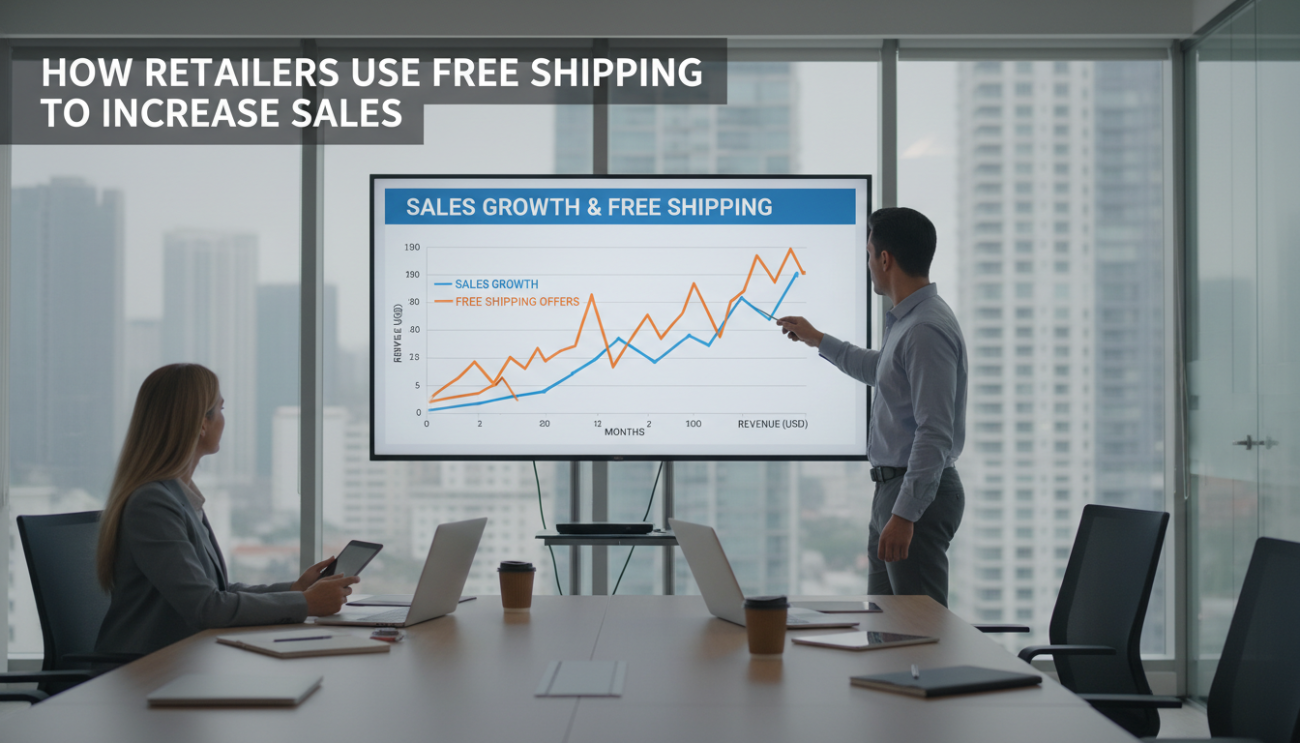
The phrase “free shipping” is one of the most powerful marketing tools in the modern retail landscape. For consumers, it represents a simple, clear-cut benefit: the final price is the price they see, with no hidden fees at checkout. For retailers, however, the concept is far more complex. Shipping is never truly free; someone, somewhere, is paying the cost. The art of using free shipping to boost sales lies in mastering the financial and psychological trade-offs to ensure that the increased revenue and customer loyalty outweigh the expense.
This article will explore the practical strategies, real-world constraints, and careful calculations that retailers—from small e-commerce shops to global giants—employ to turn a shipping cost into a powerful sales driver.
The Psychology of Zero: Why “Free” Works
To understand why free shipping is so effective, one must first appreciate the deep-seated psychological effect of the word “free.” Behavioral economists refer to this as the Zero-Price Effect [1]. When a product or service is offered for zero cost, its perceived value often increases disproportionately, leading to a strong emotional pull that can override rational decision-making.
For the customer, a shipping fee is often perceived as a “tax” on the purchase—a necessary but frustrating expense that adds no intrinsic value to the product itself. This feeling contributes significantly to the high rate of shopping cart abandonment, which hovers around 70% across the e-commerce industry [2]. When a customer reaches the checkout page and sees an unexpected or high shipping charge, they often feel a sharp “pain of paying,” leading them to abandon the purchase entirely.
Retailers leverage this psychological hurdle by eliminating it. By offering free shipping, they remove the single largest friction point in the online buying process. Data consistently shows that a vast majority of shoppers—up to 75%—prioritize free shipping over fast shipping when making a purchase decision [3]. This preference demonstrates that the psychological benefit of avoiding a fee often outweighs the desire for immediate gratification.
Core Strategies for Profitable Free Shipping
Retailers cannot simply absorb the cost of every shipment; that would quickly lead to financial ruin. Instead, they employ carefully structured strategies designed to shift the cost, increase the average order value (AOV), or build long-term customer loyalty.
1. The Minimum Order Threshold Model
This is arguably the most common and effective strategy for small and mid-sized retailers. The goal is to set a spending requirement that customers must meet to qualify for free delivery.
How it works:
The retailer calculates their average order value (AOV) and then sets the free shipping threshold slightly higher. For example, if a retailer’s AOV is $45, they might set the threshold at $50 or $75. This encourages customers who are close to the threshold to add an extra item to their cart to avoid paying a $7 or $10 shipping fee. Research shows that up to 80% of online shoppers are willing to meet a minimum purchase requirement to qualify for free shipping [4].
Real-World Examples:
Many successful e-commerce brands use this model. Retailers like Allbirds, Brooklinen, and Gymshark often set clear, achievable thresholds that nudge customers to purchase a second item or a higher-priced product. This strategy effectively turns the shipping cost into a marketing tool that drives up revenue, allowing the retailer to cover the shipping expense with the higher profit from the larger order.
2. The “Baked-In” Cost Model
In this straightforward approach, the retailer simply incorporates the average shipping cost into the product’s price. The customer sees “free shipping” on the product page, but they are, in fact, paying for the delivery within the higher sticker price.
How it works:
If a product costs $20 to manufacture and the average shipping cost is $5, the retailer prices the item at $29.99 instead of $24.99 plus $5 shipping.
Trade-offs:
This model is excellent for conversion rates and simplicity, as it offers site-wide free shipping without eroding margins. However, it can make the retailer’s products appear more expensive when compared side-by-side with competitors who list a lower product price and a separate shipping fee. This strategy is most effective for unique or high-value items where price comparison is less direct.
3. The Membership Model
The membership model transforms free shipping from a transaction-based incentive into a loyalty program benefit. The most famous example is Amazon Prime, which offers unlimited free two-day shipping in exchange for an annual fee.
How it works:
Customers pay a recurring fee, which provides the retailer with a guaranteed, upfront revenue stream. This revenue helps subsidize the shipping costs for all members. Once a customer has paid the membership fee, they are heavily incentivized to shop exclusively with that retailer to maximize the value of their subscription. This drives incredible customer retention and lifetime value (CLV).
Trade-offs:
This model requires significant scale and logistical infrastructure to execute profitably. For smaller retailers, a variation might involve a paid VIP program or a loyalty tier that unlocks free shipping after a certain number of purchases.
4. The Free Returns Model
While technically about returns, this strategy is inextricably linked to free shipping and is a powerful tool for reducing purchase anxiety, particularly for apparel and footwear. Zappos built its entire brand around this concept, offering free shipping and a generous 365-day free return policy [5].
How it works:
By removing the risk of a bad fit or an unwanted item, the retailer encourages the initial purchase. The customer knows that if the item doesn’t work out, they won’t be penalized with shipping costs. This dramatically increases conversion rates, even if it leads to a slightly higher return rate. The retailer accepts the cost of return shipping as a necessary investment in customer trust and brand loyalty.
The Real-World Constraints and Costs
The biggest misconception about free shipping is that it is a simple marketing decision. In reality, it is a complex logistical and financial challenge. Retailers must confront the fact that shipping costs are a major operational expense.
The Financial Reality: Who Pays?
When a retailer offers free shipping, the cost is covered in one of three ways:
- The Customer Pays (Indirectly): The cost is “baked into” the product price or covered by the higher AOV generated by a minimum threshold.
- The Retailer Pays (Reduced Margin): The retailer absorbs the cost, resulting in a lower profit margin on that specific transaction.
- The Carrier Pays (Discounted Rate): The retailer negotiates a bulk discount with carriers like USPS, UPS, or FedEx due to high volume, effectively lowering the base cost.
For small businesses, the challenge is acute. They lack the massive shipping volume of Amazon or Walmart, which means they pay higher per-package rates. This makes the minimum order threshold strategy even more critical for survival.
The Logistics Challenge: Weight, Distance, and Speed
Shipping costs are primarily determined by three factors:
| Factor | Constraint | Retailer Strategy |
|---|---|---|
| Weight/Dimensions | Carriers use dimensional weight (DIM) pricing, meaning large, light packages can cost as much as small, heavy ones. | Optimize packaging to be as small and light as possible. Use poly mailers instead of boxes when feasible. |
| Distance | The “last mile” of delivery is the most expensive part of the journey. Shipping across zones (e.g., coast-to-coast) is costly. | Limit free shipping to local or regional zones. Use regional fulfillment centers or third-party logistics (3PL) providers. |
| Speed | Expedited shipping (2-day or next-day) is significantly more expensive than ground shipping. | Clearly communicate that “free” means standard ground shipping (5-7 days). Offer faster shipping as a paid upgrade. |
To manage these costs, many retailers partner with a 3PL provider or use fulfillment services offered by platforms like Shopify. These services allow smaller businesses to access better carrier rates and distribute inventory closer to customers, reducing the average shipping distance and cost.
Actionable Guidance for Implementing Free Shipping
For the beginner or intermediate retailer, implementing a free shipping strategy requires careful calculation and testing. Here is a practical, step-by-step guide to setting up a profitable program.
Step 1: Calculate Your True Shipping Cost
Before offering anything “free,” you must know your actual expense.
- Average Shipping Cost (ASC): Calculate the total amount spent on shipping over the last six months and divide it by the total number of orders. This gives you a baseline cost per order.
- Average Order Value (AOV): Calculate the total revenue over the last six months and divide it by the total number of orders.
- Profit Margin: Determine the gross profit margin for your products. This will tell you how much room you have to absorb the ASC.
Step 2: Set the Minimum Threshold
Use your AOV and ASC to find the sweet spot for your minimum order threshold (MOT).
Formula:
$$\text{MOT} = \text{AOV} + (2 \times \text{ASC})$$
If your AOV is $40 and your ASC is $8, a good starting MOT would be $40 + (2 \times \$8) = \$56$. This threshold is high enough to ensure that the increased revenue from the extra items covers the $8 shipping cost and still leaves a healthy profit.
Step 3: Define Clear Conditions
Your free shipping policy must be transparent and easy to understand. Avoid frustrating customers with fine print at the last minute.
- Geographic Limits: Specify if the offer is limited to the continental US, a specific state, or international zones.
- Exclusions: Clearly state if heavy, oversized, or discounted items are excluded from the offer.
- Delivery Time: Always specify the expected delivery window (e.g., “Free Standard Shipping (5-7 Business Days)”).
Step 4: Communicate the Value
The free shipping offer should be visible everywhere—on the homepage banner, in the product descriptions, and prominently in the shopping cart. Use language that highlights the benefit, such as: “You are only $12 away from free shipping!” This constant reminder is what drives the psychological impulse to spend more.
Step 5: Test and Refine
The MOT is not static. You must continually monitor two key metrics:
- Conversion Rate: Does the free shipping offer lead to more completed purchases?
- Average Order Value (AOV): Is the AOV increasing to a point where the free shipping cost is covered?
If your AOV is not rising, your threshold may be too high, or your customers may not have enough low-cost add-on items to push them over the limit. If your profit margins are shrinking, your threshold may be too low, or your product pricing may need adjustment.
Conclusion: The Trade-Offs of Free Shipping
Free shipping is not a magic bullet; it is a strategic investment. Retailers who succeed with it understand that they are trading a direct, visible cost (shipping fee) for an indirect, powerful benefit (increased sales volume, higher AOV, and superior customer loyalty).
| Benefit | Trade-Off |
|---|---|
| Increased Conversion | Reduced profit margin on smaller orders. |
| Higher Average Order Value (AOV) | Increased complexity in inventory and fulfillment. |
| Superior Customer Loyalty | Higher initial investment in logistics and membership programs. |
| Competitive Advantage | Pressure to continually lower the free shipping threshold. |
For the retailer looking to grow, the question is not if you should offer free shipping, but how you can structure it to be a profitable engine for growth. By focusing on the numbers, understanding the psychology, and being realistic about the costs, any retailer can effectively use this powerful tool to boost their sales and build a loyal customer base.
References
[1] The Zero-Price Effect: How a Price of Zero Influences Decisionmaking. St. Louis Fed. https://www.stlouisfed.org/publications/page-one-economics/2025/apr/psychology-of-free-how-price-of-zero-influences-decisionmaking
[2] Baymard Institute. Shopping Cart Abandonment Rate Statistics. https://baymard.com/lists/cart-abandonment-rate
[3] FedEx. What Customers Want in Shipping. https://www.fedex.com/en-us/shipping/what-customers-want.html
[4] Shopify. Free Shipping Guide: 8 Strategies to Boost Sales. https://www.shopify.com/blog/free-shipping-and-conversion
[5] Zappos. Shipping and Returns Policy. https://www.zappos.com/c/shipping-and-returns