Last Reviewed On: January 10, 2026
In the ever-expanding landscape of online shopping, the allure of a great deal is undeniable. Coupon codes offer a tantalizing promise of savings, transforming a full-price item into an irresistible bargain. However, this digital gold rush has also paved the way for a less savory side of the internet: fake coupon code websites. These platforms, often designed to mimic legitimate services, can lead to frustration, wasted time, and even significant privacy and security risks. This article aims to equip you with the knowledge and strategies to navigate this complex terrain, ensuring your pursuit of savings remains safe and fruitful.
Who This Is For / Not For
This article is for:
- Beginners and early intermediates in online shopping who are tired of “Click to Reveal” buttons that lead nowhere.
- Privacy-conscious shoppers who want to save money without accidentally handing over their personal data to a data broker.
- Anyone frustrated by the “coupon code not valid” error message and looking for a more reliable way to shop.
This article is not for:
- Extreme couponers who already have a 50-tab spreadsheet and know every trick in the book.
- Anyone looking for “hacks” to get items for free illegally. We focus on legitimate, real-world savings and the tradeoffs involved.
- Get-rich-quick seekers. There is no magic button for wealth here—just practical advice on keeping your $5 in your pocket where it belongs.
The Allure and the Deception: Understanding Fake Coupon Sites
The promise of a significant discount can be a powerful motivator. Retailers frequently offer promotional codes to attract new customers, reward loyal ones, or clear out inventory. This legitimate practice has, unfortunately, been co-opted by malicious actors who create websites designed to capitalize on shoppers’ eagerness for savings. These fake sites often employ sophisticated tactics to appear credible, making it challenging for an unsuspecting user to differentiate them from genuine platforms.
The core deception lies in presenting non-existent, expired, or misleading coupon codes. While some might simply waste your time, others pose more severe threats, ranging from data harvesting to malware installation. It is important to understand that these sites are businesses, but their “product” isn’t a discount—it’s your attention and your data. The goal of these fraudulent sites is rarely to help you save money; instead, it’s often to profit from your clicks, personal information, or even by compromising your device [1]. This is a classic example of the “if the product is free, you are the product” tradeoff that defines much of the modern web.
Identifying the Red Flags: What to Look Out For
Recognizing a fake coupon website often comes down to a keen eye for detail and a healthy dose of skepticism. Here are some critical red flags to watch for:
1. Suspicious URLs and Website Design
- Misspellings and Typos: Fraudulent sites frequently use URLs that are slight variations or misspellings of legitimate brand names (e.g., “Amaz0n” instead of “Amazon” or “Nikee” instead of “Nike”) [2]. Always double-check the URL for accuracy.
- Unusual Domain Extensions: While not always a definitive sign, be wary of unfamiliar or generic domain extensions (e.g.,
.xyz,.top,.club) for established brands that typically use.com,.org, or country-specific domains. - Poor Quality Design: Although some scam sites are well-designed, many still exhibit signs of rushed or unprofessional creation, such as inconsistent branding, low-resolution images, or awkward phrasing.
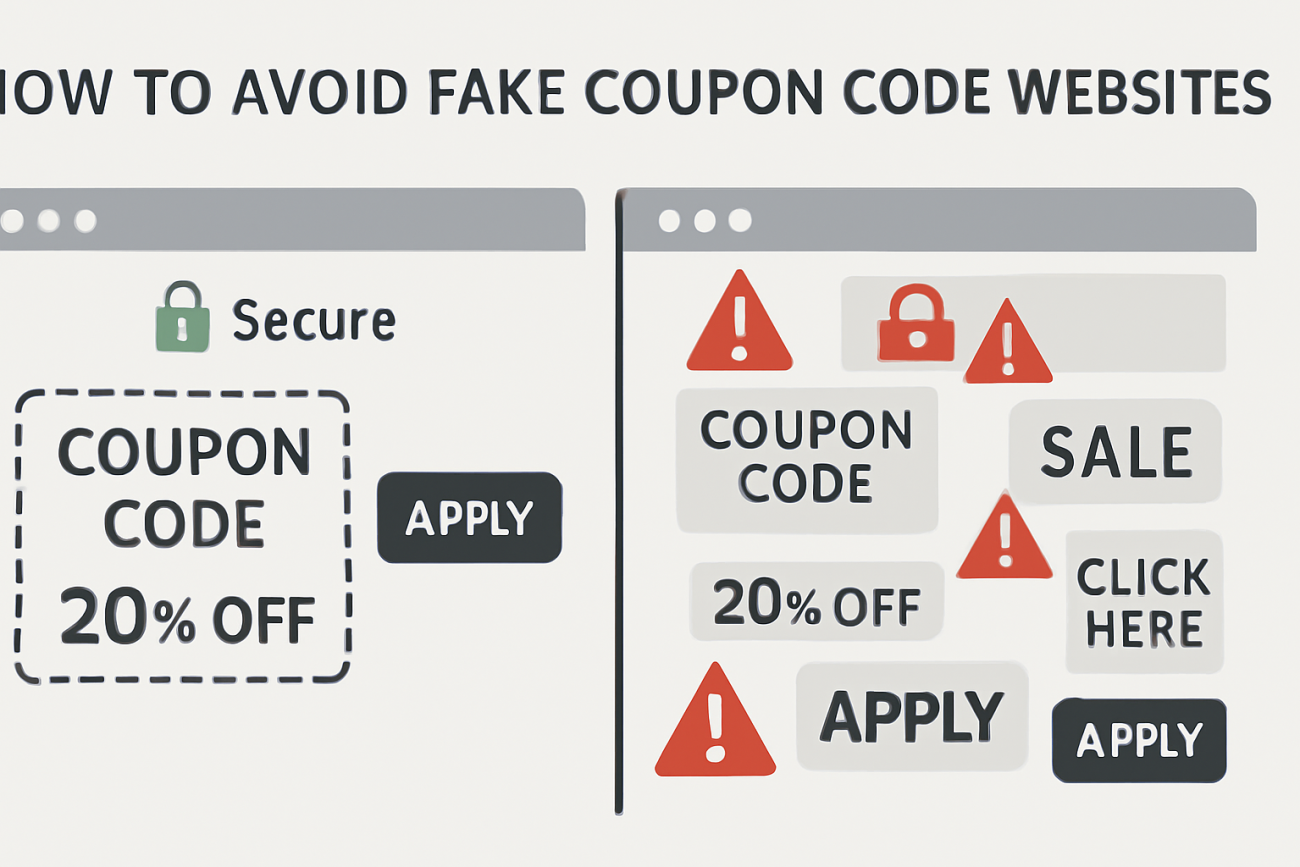
- Lack of Secure Connection (HTTPS): Always look for “https://” at the beginning of the URL and a padlock icon in your browser’s address bar. This indicates a secure connection, though its presence alone doesn’t guarantee legitimacy, its absence is a major red flag.
2. Unrealistic Offers and Lack of Detail
- “Too Good to Be True” Discounts: A coupon offering 90% off a brand-new, high-demand item with no apparent restrictions should immediately raise suspicion. While deep discounts exist, they usually come with clear terms and conditions.
- Missing Fine Print: Legitimate coupons always have fine print detailing expiration dates, exclusions (e.g., “excludes clearance items”), minimum purchase requirements, and eligible products or services. The absence of such details is a strong indicator of a fake offer [3].
- Vague Error Messages: When attempting to use a code from a suspicious site, you might encounter generic error messages like “coupon not valid” or “an error occurred” without any specific explanation. This is a common tactic to mask non-existent codes [4].
3. Demands for Excessive Personal Information
- Requests for Unnecessary Data: Be extremely cautious if a website demands extensive personal information (e.g., full name, address, phone number, email, date of birth) merely to “reveal” a coupon code. Legitimate coupon sites rarely require more than an email address for newsletters, and certainly not sensitive data like credit card details to access a code [1].
- “Unlock” or “Verify” Schemes: Some sites will claim you need to complete surveys, download apps, or provide personal data to “unlock” a coupon. These are often ploys to harvest your data or generate ad revenue for the scammers.
4. Aggressive Pop-ups and Redirects
- Overwhelming Ads: Websites inundated with aggressive pop-up ads, new tabs opening unexpectedly, or constant redirects to other sites are often designed to generate ad revenue rather than provide genuine value. This can also be a sign of adware or malware [5].
- Browser Extension Prompts: Be wary of sites that aggressively prompt you to install browser extensions. While some extensions are legitimate, malicious ones can track your browsing, inject ads, or steal data [6].
The Hidden Costs: Beyond Just Wasted Time
The consequences of interacting with fake coupon code websites extend far beyond the frustration of a non-working discount. There are tangible risks to your privacy, security, and even your financial well-being.
Privacy Concerns
Many fake coupon sites are sophisticated data harvesting operations. By requesting your email, phone number, or other personal details, they build profiles that can be sold to third parties, used for targeted spam, or even for more elaborate phishing attacks. The “free” coupon comes at the cost of your personal data, which can have long-term implications [1].
Security Risks: Malware and Phishing
Clicking on links from untrustworthy sites or installing dubious browser extensions can expose your device to malware, adware, and viruses [5]. This malicious software can:
- Track Your Online Activity: Silently monitor your browsing habits, search queries, and even keystrokes.
- Inject Unwanted Ads: Flood your browser with intrusive advertisements.
- Steal Sensitive Information: Compromise login credentials, financial details, and other sensitive data stored on your device.
- Phishing Attacks: Redirect you to fake login pages for banking, email, or social media, designed to steal your credentials [2].
Affiliate Hijacking and Misdirection
Some fake coupon sites engage in a practice known as affiliate hijacking. They might display codes that don’t work but encourage you to click through to the retailer’s site. When you do, a cookie is dropped on your browser, attributing any subsequent purchase to the fake coupon site’s affiliate link. This means legitimate content creators or cashback services that should have earned a commission lose out, and the fraudulent site profits from your purchase without providing any real value [7].
Finding Legitimate Savings: A Trustworthy Approach
Navigating the world of online coupons doesn’t have to be a minefield. By focusing on trusted sources and adopting smart habits, you can enjoy genuine savings without compromising your security.
1. Start Directly with the Retailer
The most reliable place to find coupon codes is directly on the retailer’s official website. Look for sections like “Promotions,” “Deals,” “Coupons,” or sign up for their email newsletter. Many retailers offer exclusive discounts to subscribers.
2. Utilize Reputable Coupon Aggregators and Browser Extensions
Several well-established platforms specialize in aggregating and verifying coupon codes. These services often have large communities that report on the validity of codes, and many integrate directly into your browser to automatically apply available discounts. While no service is perfect, these are generally far more reliable than obscure websites.
Here are some widely recognized options:
| Service Name | Primary Function | Key Features | Considerations |
|---|---|---|---|
| Rakuten | Cashback & Coupons | Earn cashback on purchases, often combines with coupon codes. | Requires activation for cashback. |
| Honey | Automatic Coupon Application | Automatically finds and applies coupon codes at checkout. | Owned by PayPal. Some users report it’s less effective than in the past [8]. |
| Capital One Shopping | Price Comparison & Coupons | Compares prices across retailers, applies coupons, tracks price history. | Requires browser extension. |
| RetailMeNot | Coupon Aggregation | Large database of user-submitted and verified coupons. | Can sometimes have expired codes due to user submissions. |
Disclosure: The author of this article did not participate in the collection of these testimonials or the development of these services. This section simply summarizes community experiences and widely recognized tools to provide a broader perspective on what is currently working for real shoppers.
3. Check Reputable Review Sites and Forums
Before making a significant purchase, a quick search on trusted consumer review sites or forums (like Reddit’s r/SavingMoney [9]) can often reveal discussions about current promotions or legitimate coupon codes. Users frequently share their experiences and verify codes in these communities.
4. Verify Time-Sensitive Claims and Regional Variability
Coupon codes, especially those for major sales events (e.g., Black Friday, Cyber Monday), are highly time-sensitive. Always check the expiration date. Furthermore, many promotions are region-specific. A code valid in the United States might not work in Canada or Europe, and vice-versa. Always confirm the terms and conditions for your specific location.
Community Insights: Learning from Others’ Experiences
Online communities are a rich source of real-world experiences regarding coupon codes. Many users express frustration with the constant search for working codes, encountering “expired links, annoying pop-ups, and codes that never actually work” [9]. This sentiment underscores the need for reliable methods and highlights the time-consuming nature of sifting through unreliable sources.
Some users have even begun experimenting with AI tools like ChatGPT or Perplexity AI to find and test coupon codes, with varying degrees of success. While these tools can aggregate potential codes, the challenge remains in verifying their functionality in real-time [9]. The consensus often points back to the efficiency of established browser extensions that automate the testing process at checkout.
“I got tired of searching for promo codes that never work, so I started using AI to find the best ones… Now it was able to let me know which codes are working and the exact one that saves me the most.” — Reddit User, r/SavingMoney [9]
This testimonial reflects a common desire for streamlined, effective solutions in a landscape often cluttered with ineffective options. It also highlights the trade-off between the time invested in searching for codes and the actual savings achieved.
Conclusion: Smart Saving in a Digital Age
The pursuit of savings online is a worthwhile endeavor, but it requires vigilance and informed decision-making. Fake coupon code websites are a persistent challenge, designed to exploit your desire for a good deal. By understanding their tactics, recognizing red flags, and prioritizing trusted sources, you can protect your privacy, enhance your online security, and genuinely save money.
Remember, if a deal seems too good to be true, it very likely is. A few moments of critical evaluation can save you hours of frustration and potential digital headaches. Shop smart, stay safe, and enjoy the real savings that the internet has to offer.
References
[1] Bitdefender. (2024, July 1). Coupon Scams: What They Are, How They Happen, and… https://www.bitdefender.com/en-us/blog/hotforsecurity/coupon-scams
[2] DFPI – CA.gov. (2025, November 24). Holiday deal or trap? How to spot the scam. https://dfpi.ca.gov/news/insights/holiday-deal-or-trap-how-to-spot-the-scam/
[3] Groupon. (2026, January 7). How to Spot Fake Coupons and Avoid Scams in 2026. https://www.groupon.com/coupons/blog/how-to-spot-fake-coupons-avoid-scams
[4] Reddit. (2023, December 31). Coupon codes that don’t work, endless excuses by… https://www.reddit.com/r/legaladvicecanada/comments/18ukftg/coupon_codes_that_dont_work_endless_excuses_by/
[5] NordVPN. (2025, June 19). Coupon fraud: How to spot and prevent coupon scams. https://nordvpn.com/blog/coupon-fraud/
[6] Welivesecurity. (2025, July 29). The hidden risks of browser extensions – and how to stay… https://www.welivesecurity.com/en/cybersecurity/hidden-risks-browser-extensions/
[7] Marcode.ai. (2024, December 11). Fake Discount Codes & Coupon Scams. https://www.marcode.ai/affiliate-hijacking/fake-discount-codes
[8] Reddit. (2024, May 29). Has anyone had Issues with Coupon Codes Leaking? https://www.reddit.com/r/shopify/comments/1gu3wrv/has_anyone_had_issues_with_coupon_codes_leaking/
[9] Reddit. (2024, May 29). I got tired of searching for promo codes that never work, so I started using AI to find the best ones. https://www.reddit.com/r/SavingMoney/comments/1kd6wzu/i_got_tired_of_searching_for_promo_codes_that/