The promise of winning something for free is always exciting, but the digital world of giveaways and sweepstakes is a minefield of legitimate opportunities and deceptive scams. For every genuine chance to win, countless fake ones lurk, aiming to steal your personal information, money, or identity. This guide will help you navigate this complex landscape, distinguishing real giveaways from fake sweepstakes, identifying giveaway red flags, and showing you how to participate safely.
Last Reviewed On: January 12, 2026. Please be aware that scam tactics evolve rapidly, and the legal frameworks governing sweepstakes can vary significantly by region and jurisdiction. Always exercise caution and verify information independently.
Who This Is For / Not For
This guide is for beginners and hobbyist “sweepers” who want to explore online freebies and sweepstakes safely, refine their discernment skills, and understand the mechanics of legitimate contests. It’s particularly useful for social media users who frequently encounter giveaway promotions. This article is not for those seeking “guaranteed” wins, believing in unrealistic promises of easy money, or those unwilling to invest time in reading official rules and verifying sources. It also isn’t for individuals who disregard privacy concerns or are comfortable sharing sensitive personal information indiscriminately.
The Golden Rule: No Purchase Necessary
If you remember only one thing from this article, let it be this: no purchase is ever necessary to enter or win a legitimate sweepstakes. This isn’t just a “best practice” or a friendly suggestion—it’s the law in the United States and many other countries. It’s a fundamental consumer protection designed to prevent companies from turning a game of chance into an illegal lottery. The Federal Trade Commission (FTC) and the U.S. Postal Inspection Service (USPIS) explicitly state that legitimate sweepstakes cannot require you to buy something, pay a fee, or make a donation to participate or claim a prize [1] [2].
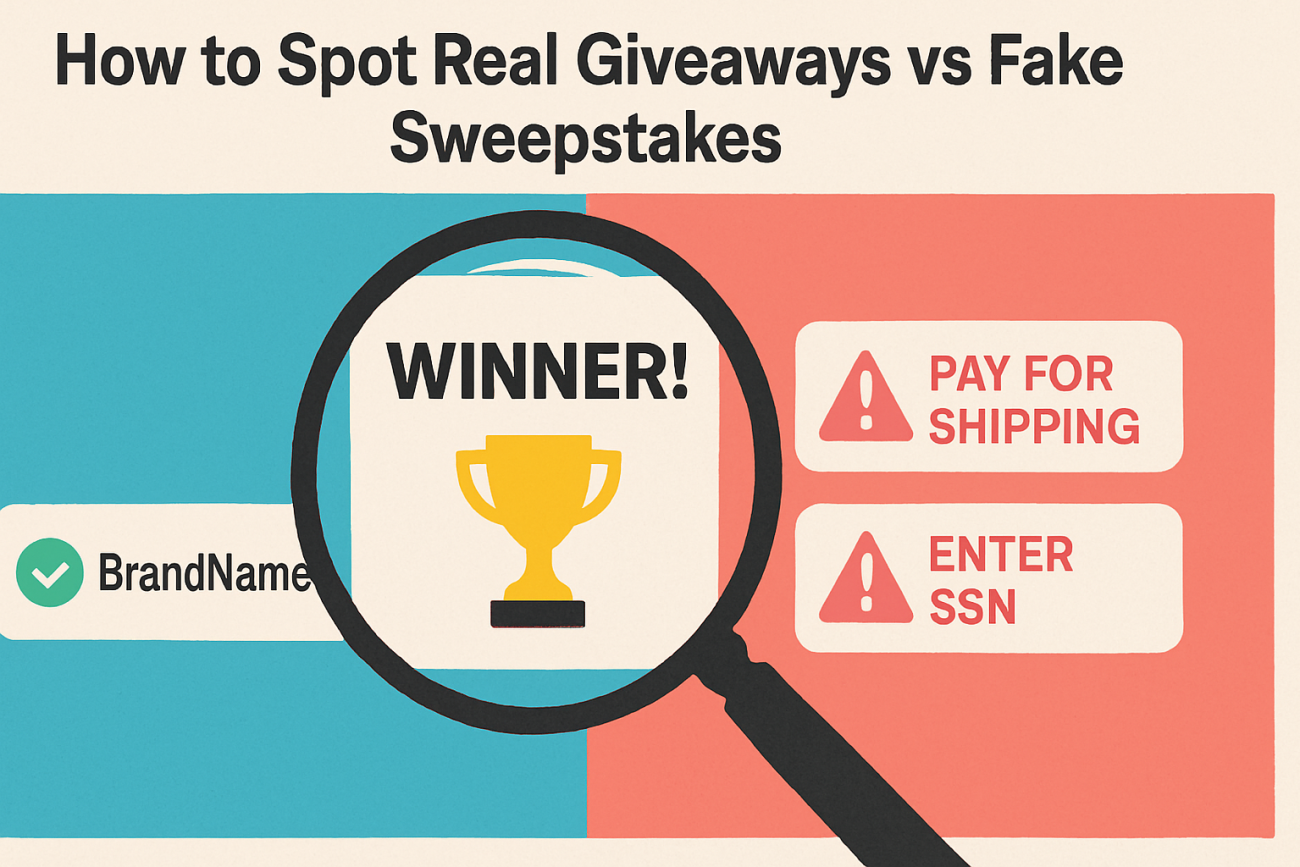
This crucial rule is your first and most important defense against fake sweepstakes. If you receive a notification that you’ve won a prize but are then asked to pay a “shipping fee,” “handling charge,” “taxes,” or any other upfront payment to receive your winnings, consider it a massive giveaway red flag. Scammers frequently use this tactic, knowing that the excitement of winning can override common sense. They might claim these fees are for customs, insurance, or administrative costs, but in reality, any money you send will go directly into their pockets, and the promised prize will never materialize. Legitimate sweepstakes sponsors are responsible for covering these costs or will arrange for taxes to be paid directly to the relevant authorities, not through the winner.
Similarly, be wary of requests to provide personal financial information beyond what is strictly necessary for prize fulfillment. While a legitimate sponsor might need your address to ship a prize, they will never ask for your bank account number, credit card details, or Social Security Number (SSN) upfront to “verify” your win. Such requests are almost always an attempt at identity theft or financial fraud. Always remember: if you have to pay to play, or pay to claim, it’s not a legitimate sweepstakes.
Top 5 Red Flags of a Fake Giveaway
Beyond the golden rule of “no purchase necessary,” several other indicators can help you quickly identify fake sweepstakes and protect yourself from scams. Recognizing these giveaway red flags is crucial for anyone hoping to participate in online giveaways safely. First, be wary of unsolicited winnings; if you didn’t enter, you can’t win. Messages claiming you’ve won a contest you don’t recall entering are almost certainly scams [3]. Second, scammers often create high pressure and urgency, demanding immediate action to “claim your prize” before a tight deadline. Legitimate organizations provide reasonable timeframes. Third, be extremely cautious of requests for sensitive data like SSNs, bank account details, or passwords. While some personal information is needed for prize fulfillment, highly sensitive data is rarely requested upfront. Fourth, look for poor professionalism such as spelling and grammar mistakes, or unverified social media accounts with few followers. Reputable brands maintain a professional image [4]. Finally, always scrutinize suspicious links that may contain misspellings or use URL shorteners to hide their true destination. Hover over links before clicking, and if anything seems off, avoid it to prevent phishing or malware.
Anatomy of a Legitimate Sweepstakes
Understanding the hallmarks of a genuine sweepstakes is just as important as recognizing the red flags of a scam. Legitimate giveaways, especially those run by reputable companies, adhere to specific legal and ethical standards that ensure fairness and transparency. Knowing what to look for can help you confidently participate in real giveaways.
Every legitimate sweepstakes must have a clearly defined set of “Official Rules” [5]. These rules, acting as the legal blueprint of the promotion, should be easily accessible via a direct link on the entry page. They typically detail critical information such as start and end dates, eligibility requirements (including age, geographic limitations, and regional variability), a clear prize description and value, the method of entry, how winners will be selected, how they will be notified, and the sponsor information. If a giveaway lacks comprehensive official rules or if they are vague, it should be treated with extreme skepticism, as transparency is a cornerstone of legitimate giveaway sites.
Legitimate sweepstakes often involve a different kind of currency: your personal data. Reputable companies will have a clear and accessible Privacy Policy explaining how your information (email, name, demographic data) will be collected, used, and shared. By entering, you often consent to receive marketing communications from the sponsor and their partners. This is a real-world constraint and a privacy tradeoff; you exchange your data for a chance to win. A missing or hard-to-find Privacy Policy is a significant warning sign.
Many legitimate sweepstakes sponsors demonstrate transparency by displaying a list of past winners on their website or social media. This provides tangible proof that people actually win. While not every small giveaway will have an extensive public list, established brands running recurring promotions often do. The absence of any mention of previous winners, especially for a recurring promotion, can be a subtle giveaway red flag.
On social media, look for verification badges (e.g., the blue checkmark) next to the brand’s name, though these aren’t foolproof. Scrutinize the account’s history: a legitimate brand will have consistent activity, a substantial following, and professional content. Be wary of new accounts, those with few followers, or suspicious posts. Always visit the brand’s official website directly to find promotions, rather than relying on social media links.
The “Real” Cost of Free: Privacy and Tradeoffs
Even legitimate giveaways come with real-world constraints and tradeoffs. Companies often use giveaways for data harvesting, collecting your email and other contact information for marketing purposes. This means “free” often translates to “free in exchange for your data,” a fundamental privacy tradeoff. Expect a marketing influx after entering, as your inbox may fill with newsletters and promotions. Many experienced participants use a dedicated “burner” email for this reason. Finally, consider the time vs. reward tradeoff: while entering sweepstakes can be time-consuming, the odds of winning, especially for valuable prizes, are typically very low. It’s crucial to have realistic expectations and weigh the time invested against the minuscule probability of a prize.
Community Experiences & Testimonials
The collective wisdom of online communities, particularly those dedicated to discussing scams and consumer protection, offers invaluable insights into the ever-evolving landscape of fake sweepstakes and giveaway scams. These real-world experiences, often shared on platforms like Reddit (especially r/Scams), provide a practical understanding of how scammers operate and the red flags to watch out for.
User Testimonials Disclosure: It is important to note that the author of this article did not participate in the creation or endorsement of the following testimonials. These are summaries of common experiences and advice shared by users in public forums, reflecting community consensus and warnings.
Online communities, particularly those on Reddit (e.g., r/Scams), offer invaluable insights into fake sweepstakes and giveaway scams. Users frequently report the “Instagram DM” scam, where an impersonator congratulates you on an unentered win and demands a “small fee” for shipping or taxes [6]. Another common tactic is influencer impersonation, where scammers create fake profiles to announce giveaways, leading to malicious links or requests for personal information. The community consistently advises scrutinizing accounts for verification and consistent activity. Scammers also use fake testimonials and bot accounts to create a false sense of legitimacy, with comments like “I actually won! It’s legit!” to encourage participation. Notifications about “random giveaways” for unentered contests are almost always phishing attempts. Finally, the “check cashing” scam involves receiving a fake check and being asked to wire back a portion for fees, leaving the victim responsible when the check bounces. These shared experiences highlight the importance of vigilance: if an offer seems too good to be true, it almost certainly is.
Actionable Checklist for Safe Entering
Navigating the world of online giveaways doesn’t have to be a gamble. By following a structured approach and employing a few key tools, you can significantly increase your chances of identifying real giveaways while sidestepping fake sweepstakes. Here’s an actionable checklist to guide your participation:
To participate in online giveaways with confidence and avoid fake sweepstakes, follow this actionable checklist. First, always read the Official Rules thoroughly, looking for clear details on eligibility, entry methods, prize descriptions, and sponsor information. If rules are missing or vague, disengage. Second, verify the sponsor by visiting their official website directly and checking their social media for verification badges and consistent activity. Third, confirm the “No Purchase Necessary” clause; any request for payment for taxes, shipping, or fees is a definitive red flag. Fourth, use a “burner” email address to protect your primary inbox from marketing influx and potential spam. Fifth, be wary of requests for sensitive information like SSNs or bank details upfront; legitimate sponsors will use secure, verifiable channels for tax forms if needed. Sixth, examine links carefully by hovering over them to check for misspellings or unusual domains, and manually navigate to official sites if unsure. Seventh, employ an ad-blocker and antivirus software (like uBlock Origin) to prevent malicious pop-ups and scan downloaded files. Eighth, trust your gut; if an offer seems too good to be true or creates undue pressure, step back. Finally, consult community resources like r/Scams on Reddit if you’re unsure about a giveaway, as shared experiences can help identify potential scams. By diligently following these steps, you can enjoy the fun of potential winnings while safeguarding your personal information and financial security.
Conclusion
The digital landscape of giveaways and sweepstakes is complex, offering both real giveaways and numerous fake sweepstakes. By understanding fundamental principles like “no purchase necessary” and applying a critical eye, you can navigate this world confidently. Remember that even legitimate giveaways involve real-world constraints and tradeoffs, particularly regarding your privacy and marketing communications. Your personal data is valuable, and exchanging it for a slim chance at a prize should be a conscious decision. Stay informed, recognize giveaway red flags, and use the provided checklist to protect yourself from scams and enjoy the thrill of legitimate participation. Approach every “win” with skepticism, prioritize digital security, and never let excitement override common sense.
References
[1] Federal Trade Commission. (n.d.). Lottery & Sweepstakes. Retrieved from https://www.ftc.gov/lottery-sweepstakes
[2] U.S. Postal Inspection Service. (n.d.). A Consumer’s Guide to Sweepstakes and Lotteries. Retrieved from https://www.uspis.gov/wp-content/uploads/2019/12/pub-546_consumers-guide-to-sweepstakes-lotteries_508.pdf
[3] Federal Trade Commission. (n.d.). How to Spot, Avoid, and Report Sweepstakes Scams. Retrieved from https://www.consumer.ftc.gov/articles/how-spot-avoid-and-report-sweepstakes-scams
[4] Avast. (2024, December 16). 10 telltale signs of a fake giveaway on social media. Retrieved from https://blog.avast.com/how-to-spot-a-fake-giveaway
[5] Olshan Frome Wolosky LLP. (n.d.). Sweepstakes Law Basics. Retrieved from https://www.olshanlaw.com/sweepstakes-law-basics
[6] Reddit. (n.d.). Are these giveaways scams? : r/Scams. Retrieved from https://www.reddit.com/r/Scams/comments/1bzj5ei/are_these_giveaways_scams/