Last reviewed and updated on January 6, 2026. Note: Coupon policies are subject to change by retailers at any time. Regional variability in store policies (e.g., U.S. vs. Canada) and specific item exclusions are common. Always check the store’s official coupon policy before your trip.
We have all seen the “Extreme Couponing” shows where someone walks out of a grocery store with $500 worth of food for $2.14. While those results are rare and often require 40 hours of work a week, the core principle they use is something anyone can master: Coupon Stacking.
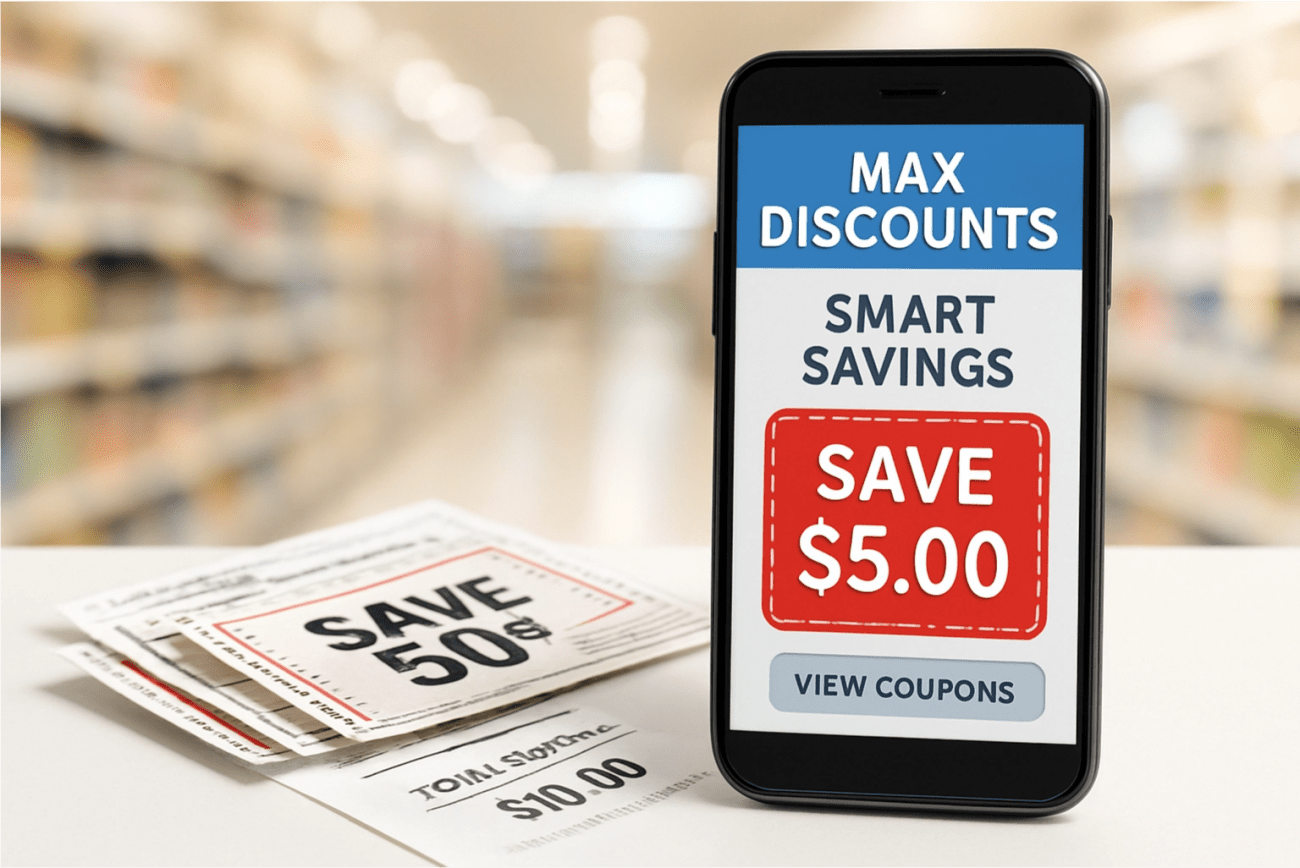
In 2026, stacking isn’t just about clipping paper from the Sunday newspaper. It is a digital game of combining store apps, manufacturer rebates, and cashback extensions to layer discounts on top of each other. When done correctly, you aren’t just getting 10% off; you are getting 50%, 70%, or even 100% off (the elusive “freebie”).
This guide will break down the “Stacking Pyramid,” the best stores for this strategy, and the real-world trade-offs you need to consider.
Who This Guide Is For (and Who It’s Not)
This guide is for:
- Beginners who want to save more than just the “sale price” at the grocery store.
- Early intermediates looking to combine digital apps with in-store promotions.
- Budget-conscious shoppers who enjoy the “thrill of the hunt” for a great deal.
This guide is NOT for:
- “Time-poor” shoppers. Stacking takes an extra 5-10 minutes per shopping trip. If your time is worth $100/hour, the $5 you save might not be worth the effort.
- Impulse buyers. Stacking requires a list and discipline. If you buy things just because they have a coupon, you aren’t saving money—you are spending it.
- Anyone looking for “glitch” deals. We only discuss legitimate, retailer-approved stacking methods.
The “Stacking Pyramid”: How to Layer Your Savings
Think of stacking like building a pyramid. You start with a solid base and add layers on top. Most retailers allow one “Manufacturer” discount and one “Store” discount per item.
- Layer 1: The Store Sale (The Base): Never use a coupon on a full-priced item if you can help it. Wait for the item to go on sale (e.g., “Buy One Get One Free” or “30% Off”).
- Layer 2: The Store Coupon: This is a discount issued by the retailer (e.g., a Target Circle offer or a Kohl’s “20% Off” pass).
- Layer 3: The Manufacturer Coupon: This is issued by the brand (e.g., a $1.00 off coupon from Tide or Kellogg’s). You can find these in store apps or on sites like Coupons.com.
- Layer 4: The Cashback App (The Peak): After you buy the item, you scan your receipt into apps like Ibotta or Fetch Rewards to get cash back.
“The magic happens when you use a manufacturer coupon on an item that is already on a store sale. That is the ‘Double Dip’ that leads to the biggest savings.” — A common mantra among professional shoppers.
1. The Best Stores for Stacking in 2026
Not all stores are created equal. Some are “Stacker Friendly,” while others have strict “One Coupon Per Transaction” rules.
Kohl’s
Kohl’s is the undisputed king of stacking in the retail world.
- The Stack: You can often combine a %-off coupon (e.g., 20% off), a $-off coupon (e.g., $10 off $50), and your “Kohl’s Cash” all in one transaction.
- Pro Tip: Always check if you have “Kohl’s Rewards” points, which act like a fourth layer of savings.
CVS Pharmacy
CVS uses a system called “ExtraBucks” (ECBs), which are essentially store credit earned on specific purchases.
- The Stack: Use a manufacturer coupon + a CVS store coupon (from the “Red Box” or app) + ECBs from a previous purchase.
- Expertise: The Krazy Coupon Lady notes that CVS is one of the few places where you can consistently get household essentials (like toothpaste and shampoo) for free by “rolling” your ExtraBucks from one week to the next.
Target
Target’s “Target Circle” program is built for stacking.
- The Stack: One Target Circle %-off offer + one manufacturer coupon + 5% off if you use a Target Circle Card.
2. Advanced Stacking: Catalinas and Overage
Once you master the basics, you can move into the “Pro” techniques.
The “Catalina” Coupon
Have you ever noticed a long strip of coupons printing out next to your receipt at the grocery store? Those are Catalina coupons.
- How they work: They are triggered by what you buy. If you buy a specific brand of cereal, the machine might print a coupon for a competitor’s brand or a “$-off your next order” coupon.
- The Stack: These are considered “Manufacturer” coupons if they have a brand name on them, or “Store” coupons if they say “$-off your next order.” You can stack them with your digital coupons for massive savings.
The “Overage” Policy
This is the holy grail of couponing. Overage happens when a coupon’s value is higher than the price of the item (e.g., a $3.00 coupon for a $2.50 item).
- The Reality: In 2026, most stores (like Walmart and Kroger) have changed their policies to “adjust” the coupon down to the price of the item. However, some stores like Publix may still allow the overage to be applied to the rest of your groceries.
- Attribution: Consumer advocacy experts at NerdWallet warn that overage is becoming increasingly rare as retailers move toward digital-only systems that automatically prevent it.
3. Digital Tools: The “Auto-Stackers”
In 2026, you don’t have to do all the math yourself. Browser extensions and apps can do the heavy lifting.
- Honey: This browser extension automatically tests every known promo code at checkout. It is best for “Layer 2” (Store Coupons).
- Rakuten: This is the gold standard for “Layer 4” (Cashback). It doesn’t lower the price at checkout, but it sends you a “Big Fat Check” every quarter.
- Ibotta: Specifically for groceries. You “unlock” offers in the app, buy the items, and scan your receipt. It is often the only way to get a discount on “fresh” items like milk or produce.
4. The Real-World Constraints: Trade-offs and “Gotchas”
Stacking sounds like free money, but there are real costs involved.
- Privacy Issues: To use digital coupons, you must use the store’s app. This means the store is tracking exactly what you buy, when you buy it, and how often. This data is used to build a “consumer profile” that dictates what ads you see across the internet.
- The “Filler” Trap: Some coupons require a minimum spend (e.g., “$5 off $25”). If you only have $22 worth of stuff you actually need, you might spend $3 on junk just to “save” $5. You have only saved $2, and you have $3 of clutter.
- Policy Fatigue: Cashiers aren’t always experts on their own store’s coupon policy. You may occasionally run into a situation where a stack is rejected. Always be polite. It is never worth arguing over 50 cents.
5. Step-by-Step: Your First Stack
If you want to try this today, here is the simplest “Starter Stack” at a grocery store:
- Download the App: Download the app for your local grocery store (e.g., Kroger or Publix).
- Clip the “Digital Coupons”: Look for the “Digital Coupons” section and clip everything for items you already buy.
- Check the Weekly Ad: Look for items that are “On Sale” this week.
- Match Them Up: Find an item that is both “On Sale” and has a “Digital Coupon.”
- The Final Layer: After you buy it, check Ibotta to see if there is a rebate for that same item.
Summary Table: Stacking Strategy Comparison
| Strategy | Difficulty | Best For | Potential Savings |
|---|---|---|---|
| The Double Dip | Easy | Groceries | 20-40% |
| The Kohl’s Triple | Medium | Clothing/Home | 50-70% |
| The Receipt Scan | Easy | Everything | 1-5% (Cashback) |
| The “Rolling” ECBs | Hard | Pharmacy/Toiletries | 80-100% |
| The Catalina Stack | Medium | Brand Loyalty | 30-50% |
User Testimonials: Lessons from the Community
Note: The author of this article did not participate in these experiences; these are summaries of documented community discussions from platforms like Reddit’s r/couponing, Facebook’s “Learn to Qpon” group, and various “frugal living” forums.
- The “Target” Win: “I waited for a ‘Spend $50 on Household Essentials, Get a $15 Gift Card’ deal at Target. I used three $2 manufacturer coupons for the detergent I was buying. I ended up getting $55 worth of stuff for about $34, plus I got the $15 gift card for next time. That’s a 65% total value save.”
- The “CVS” Booster: “I combined a ‘20% off your entire order’ CVS email coupon with a digital manufacturer coupon for shampoo. Then I used $5 in ExtraBucks I earned last week. I paid $0.42 for two bottles of high-end shampoo. The key is checking the app before you walk into the store.”
- The “Honey” Warning: “I used to rely on Honey for everything, but I realized it sometimes misses the ‘exclusive’ codes sent to my email. Now I check my ‘Promotions’ folder first, then let Honey try to find something better.”
- The “Ibotta” Lesson: “I once bought a brand of yogurt I hated just because it was ‘Free after Ibotta.’ I ended up throwing it away. Now I only stack on things my family actually eats. A free item you don’t use is just a waste of space.”
Final Thoughts
Stacking is a skill, and like any skill, it takes practice. Don’t try to be an “Extreme Couponer” on your first day. Start by trying to stack just one item per trip.
The goal isn’t to spend your life clipping coupons; it’s to make sure that when you do spend your hard-earned money, you are getting the absolute maximum value for it.
Stay organized, stay patient, and enjoy the “Big Fat Checks” from your cashback apps!
Disclaimer: This article is for informational purposes only. The author is not affiliated with the companies or apps mentioned. While we strive for accuracy, coupon policies change frequently. Always verify the terms on the retailer’s official website or app before your purchase.