Last Reviewed on: January 6, 2026
The two most powerful words in retail are arguably “sale” and “free.” When they combine—as in “free shipping”—they create a powerful incentive that drives billions of dollars in e-commerce every year. But as any seasoned shopper or business owner knows, nothing is truly free. The cost of moving a package from a warehouse to your doorstep is a real expense, involving fuel, labor, packaging, and logistics. So, if you aren’t paying for it, who is?
This article will break down the economics of “free shipping,” revealing the pricing strategies merchants use to cover this cost and the often-overlooked trade-offs consumers make in the process. Our goal is to provide a clear, realistic, and educational perspective so you can shop with complete transparency.
Who This Is For / Not For
This guide is designed for beginners and early intermediate online shoppers who want to understand the mechanics of e-commerce pricing. If you have ever wondered why one store offers free shipping and another charges a flat rate, or if you want to become a more savvy consumer, this is for you.
This article is not for those seeking “get rich quick” schemes, guaranteed ways to always find the lowest price, or advanced logistics professionals. We avoid hype and focus on the clear, actionable reality of retail economics.
The Psychology of the Zero-Price Effect
The concept of “free” is a psychological phenomenon that fundamentally alters our decision-making process. Behavioral economists refer to this as the zero-price effect [1]. When a product or service is offered for free, its perceived value often jumps disproportionately higher than the actual monetary saving.
In the context of online shopping, this effect is potent. Research consistently shows that consumers prioritize free shipping over almost any other incentive [2].
| Consumer Preference | Percentage of Shoppers |
|---|---|
| Will not purchase without free shipping | 62% |
| Prefer free shipping over expedited shipping | 82% |
| Abandon cart due to extra shipping costs | 48% |
| Willing to wait longer for free international shipping | 66% (in some regions) |
Source: SellersCommerce, PRN Survey, Deloitte Study [2] [3]
This overwhelming preference means that “free shipping” is no longer a bonus; it is a mandatory cost of doing business for most e-commerce retailers. The question for the merchant is not if they will offer it, but how they will pay for it.
The Merchant’s Math: Where the Cost Goes
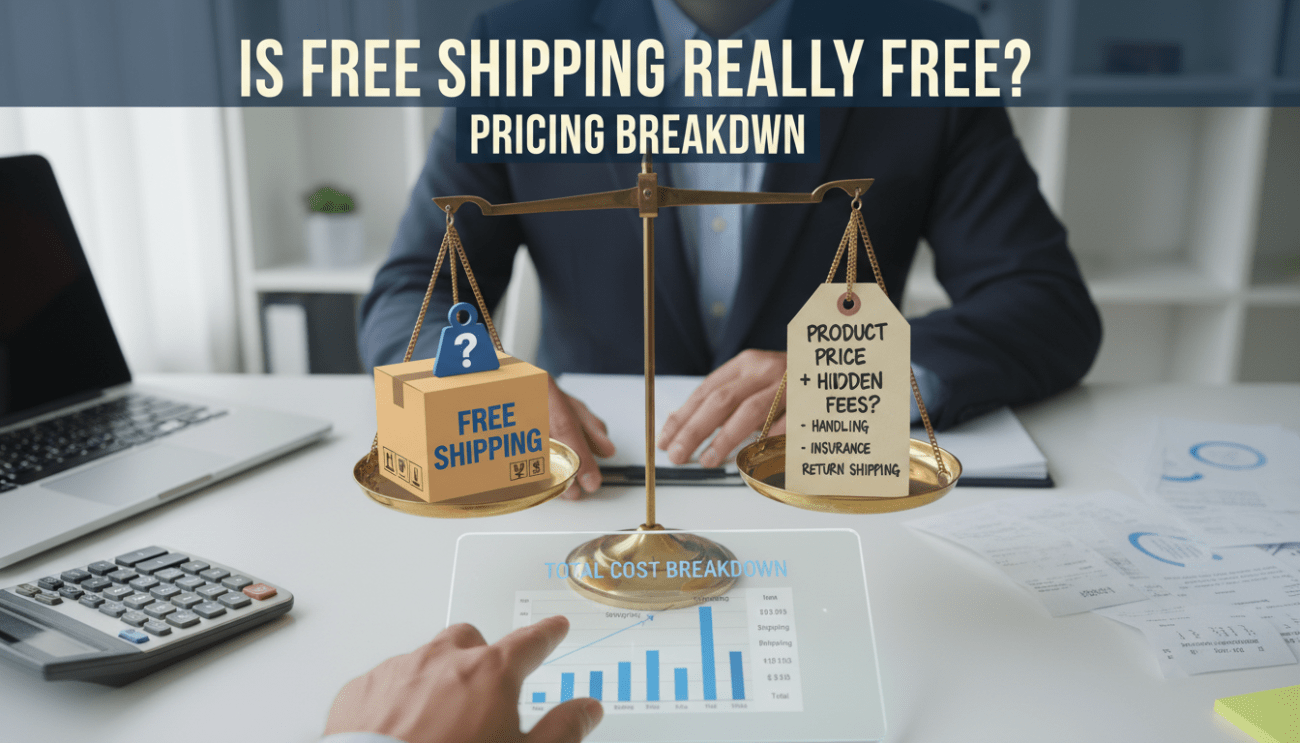
When a retailer offers you “free shipping,” they are not eliminating the cost; they are simply moving it from the checkout page to another part of their business model. The cost of shipping—which involves packaging, labor, carrier fees (like those from FedEx or UPS), and insurance—must be covered.
Here is a breakdown of the four primary ways merchants integrate this cost into their pricing structure:
1. The Cost Shift: Baking the Price In
The most common and transparent strategy is to simply markup the product price to absorb the average shipping cost. This is the core of the “Is it really free?” question.
For example, a product that costs a retailer $10 to make and $5 to ship might be listed for $15 plus $5 shipping, or it might be listed for $20 with “free shipping.” In both scenarios, the total price to the consumer is the same.
As one seller noted in an online forum, “There’s no such thing as free shipping. Most companies add the shipping costs into the total retail mark-up price and market it as ‘free'” [4]. This strategy is effective because consumers are psychologically more sensitive to a separate, explicit shipping fee than they are to a slightly higher product price.
2. The Minimum Order Threshold (MOT)
The Minimum Order Threshold (MOT) is a strategic tool designed to increase the Average Order Value (AOV) for the retailer. By offering free shipping only after a customer spends a certain amount (e.g., “Free Shipping on orders over $50”), the merchant ensures that the profit margin on the larger order is sufficient to cover the shipping cost.
This is a highly effective tactic, as approximately 80% of customers are willing to meet the MOT to avoid a shipping charge [2]. However, there is a clear disparity between what consumers are willing to spend and what retailers require:
| Metric | Average Value |
|---|---|
| Average consumer willingness to spend to qualify for free shipping | $43 |
| Average retailer-set minimum order value for free shipping | $64 |
Source: Stamp, SellersCommerce [2]
This gap shows that while the MOT works, it often pushes consumers to buy items they may not have otherwise purchased, a classic trade-off for the “free” perk.
3. The Membership Model: The Subscription Cost
For major e-commerce players, the cost of shipping is covered by a recurring subscription fee. The most prominent example is Amazon Prime [5].
In this model, the consumer pays an annual or monthly fee, which effectively pre-pays for the shipping on all future orders. The perceived value of “free two-day shipping” is so high that it becomes the primary driver for membership: a study found that 79% of Amazon Prime subscribers say they are members specifically because of the free shipping feature [2].
While this model provides convenience, it introduces a significant trade-off, which we will discuss in the transparency section: data and privacy.
4. The Loss Leader Strategy
In some cases, especially with large retailers like Amazon or Walmart, shipping is treated as a loss leader. A loss leader is a product or service sold at a loss (or at a very low profit margin) to stimulate other, more profitable sales.
These companies can afford to absorb the shipping cost, sometimes losing money on the transaction, because they gain something more valuable: customer loyalty, market share, and long-term customer data. Small businesses, however, cannot easily replicate this strategy, which is why they often struggle to compete with the “free shipping” standard set by the industry giants [4].
Case Study: How Major Retailers Deliver “Free” Shipping
To illustrate these strategies in the real world, we can look at how the largest e-commerce players structure their “free shipping” offers. Each company uses a slightly different combination of the four strategies above, creating a complex landscape for the consumer.
| Retailer | Primary “Free Shipping” Strategy | Cost to Consumer | Hidden Trade-Off |
|---|---|---|---|
| Amazon | Membership (Prime) & Loss Leader | Annual/Monthly Fee (Prime) or $35+ MOT (Non-Prime) | Data collection, ecosystem lock-in, slower standard shipping for non-members. |
| Walmart | Membership (Walmart+) & MOT | Annual/Monthly Fee (Walmart+) or $35+ MOT (Non-Member) | Reliance on local store inventory, less flexibility in choosing delivery speed. |
| Target | Loyalty Program (Circle Card) & MOT | Free (with Circle Card) or $35+ MOT (Non-Cardholder) | Requirement to use a store-branded card (debit or credit) for the best perk, which may encourage debt or limit payment options. |
| Best Buy | Tiered Membership | Annual Fee ($49.99 – $179.99) or $35+ MOT (Non-Member) | High annual fee for the best shipping speed, often bundled with unnecessary tech support services. |
Amazon: The Ecosystem Lock-in
Amazon [5] perfected the Membership Model. While non-Prime members can get free shipping on orders over $35, the true incentive is Amazon Prime. The annual fee pre-pays the shipping cost, but more importantly, it locks the customer into the Amazon ecosystem. The convenience of “free” two-day shipping is so compelling that many consumers stop price-checking competitors, trusting that the total cost will be lower—a trust that is not always warranted. Consumers often report that items eligible for Prime shipping can have a higher base price than the same item sold by a third-party seller with a separate shipping fee.
Walmart: The Store-Powered Advantage
Walmart [8] uses its massive network of physical stores to compete. Their Walmart+ membership offers free shipping with no minimum order and free same-day delivery from local stores on grocery orders over $35. This strategy leverages their existing infrastructure, turning their physical locations into mini-distribution centers. For the consumer, the trade-off is often a reliance on local store inventory, which can mean a smaller selection than Amazon’s vast online marketplace.
Target: The Loyalty Loop
Target [9] primarily uses a Loyalty Program to deliver its best shipping perk. The Target Circle Card (formerly RedCard) offers free two-day shipping with no minimum order, plus a 5% discount on all purchases. This is a classic Cost Shift strategy: the 5% discount is a direct incentive to use their card, which provides Target with valuable customer data and guarantees a payment method, reducing their transaction costs. The trade-off is the pressure to use a store-branded card, which can be a financial risk for some consumers if they opt for the credit version.
Trust and Transparency: The Hidden Trade-Offs
A truly transparent pricing breakdown must go beyond just the monetary cost. When you accept “free shipping,” you are often making trade-offs involving time, privacy, and the environment. Understanding these constraints is crucial for making informed purchasing decisions.
The Time Cost: Slower Delivery
“Free” shipping is almost always the slowest shipping option. When 82% of shoppers say they would rather get free shipping over expedited shipping, they are implicitly accepting a longer waiting period [3].
For the retailer, slower shipping is cheaper because it allows them to:
- Batch orders: Consolidate multiple orders into fewer, larger shipments to save on carrier fees.
- Optimize routes: Use the most cost-effective (but not necessarily fastest) delivery routes.
- Use cheaper carriers: Opt for carriers that offer lower rates for slower delivery times.
If you need an item quickly, you will find that the true cost of expedited shipping is often quite high, highlighting the real value of the service you receive “for free” when you are willing to wait.
The Privacy Cost: Data as Currency
In the membership model (like Amazon Prime [5] or Walmart+ [8]), the annual fee is only part of the cost. The other, less visible cost is the data you provide.
When you join a membership program for “free” shipping, you are giving the retailer an unprecedented view into your purchasing habits, preferences, and browsing history. This data allows them to:
- Personalize pricing: Offer you specific deals or dynamic pricing based on your history.
- Optimize inventory: Predict demand with greater accuracy.
- Target advertising: Sell your attention to third-party advertisers.
In the digital economy, data is currency. The convenience of “free” shipping is often subsidized by the value of your consumer data, a trade-off that is rarely made explicit.
The Environmental Cost: The Price of Convenience
The expectation of “free” and fast shipping has a measurable environmental impact. The logistics of e-commerce contribute significantly to carbon emissions, and the pressure for speed exacerbates the problem.
Furthermore, the ease of “free returns” (which 45% of consumers now expect [2]) leads to a massive logistical challenge. For every $1 billion in sales, retailers typically deal with $145 million in returned merchandise [2]. This returned inventory often requires additional shipping, processing, and sometimes ends up in landfills if it is not cost-effective to restock, creating a substantial environmental footprint that is part of the hidden cost of convenience.
The Regional Variability Disclaimer
It is important to note that the availability and true cost of “free shipping” are subject to regional variability. Shipping costs are heavily dependent on distance and accessibility. Retailers often exclude remote areas, such as Alaska, Hawaii, and international destinations, from “free shipping” offers because the carrier costs are simply too high to absorb or bake into the product price without making it uncompetitive. Always check the shipping policy for your specific location.
Expertise, Experience, and Trustworthiness: What the Community Says
To provide a complete picture, we must look beyond corporate statistics and examine the real-world experiences of both consumers and small business owners. This section summarizes community discussions from various online forums and platforms, offering a ground-level view of the free shipping debate.
Disclosure: The author of this article did not participate in the following discussions. This is a summary of community experiences to provide a broader, more trustworthy perspective.
The Seller’s Dilemma
Small e-commerce sellers frequently discuss the pressure to offer “free shipping” just to keep up with larger competitors.
“I thought about changing tactic to include free shipping, but building the cost into the price. Instead of the price then shipping on top. Free shipping has made some of my items move super fast. I just offset the price a bit to make it closer to what I’d like to make per item.” — E-commerce Seller, Reddit [6]
This sentiment confirms the psychological power of “free” and highlights the business necessity of the cost-shift strategy. However, sellers of heavy or low-margin items often find this impossible.
The Buyer’s Preference for Transparency
While most consumers prefer free shipping, a significant number of savvy shoppers express a preference for transparency, especially when dealing with marketplaces.
“People IME think of this as $20 free shipping is better than $15 + $5 shipping, b/c people ‘like’ free shipping, search for it, and prefer it. I personally don’t care if something is free shipping or not, I just look at the total price. There’s plenty of times you can save money on a particular item by going to the lowest with paid shipping.” — Online Shopper, eBay Forum [7]
This perspective emphasizes that the ultimate metric for an informed consumer is the total cost of ownership. The “free” label is a marketing tactic, and the most trustworthy retailers are those who make the total price clear, regardless of how the shipping cost is presented.
Actionable Guidance for the Savvy Consumer
Now that you understand the mechanics, here is how you can use this knowledge to shop smarter and more transparently:
- Focus on the Final Price: Always compare the total cost (product price + shipping + taxes) across different retailers. A lower product price with a separate shipping fee may still be cheaper than a higher product price with “free shipping.”
- Evaluate the MOT: Before adding an unnecessary item to your cart to meet a Minimum Order Threshold, ask yourself: Is the cost of the extra item less than the shipping fee? If not, you are overspending for the “free” perk.
- Read the Fine Print: Be aware of regional exclusions, return policies, and the expected delivery time for “free” shipping. If you need an item by a specific date, be realistic about the trade-off you are making.
- Assess Membership Value: If you are considering a subscription service like Amazon Prime [5] or Walmart+ [8], calculate how many orders you place per year. Divide the annual fee by your number of orders to find the effective shipping cost per order. If you only order a few times a year, the membership fee might be more expensive than paying for shipping outright.
- Support Transparent Retailers: When possible, support small businesses that clearly break down their costs. Their honesty often reflects a commitment to a sustainable business model rather than a reliance on psychological marketing tricks.
Conclusion: The Price of Convenience
The question, “Is free shipping really free?” has a clear answer: No, it is not.
The cost of shipping is a fundamental part of e-commerce logistics, and it is always paid for—either by being baked into the product price, covered by a membership fee, or subsidized by the purchase of additional items to meet a threshold.
The real value of this knowledge lies in recognizing the trade-offs you make for the convenience of “free.” By understanding the merchant’s math and the hidden costs involving time, privacy, and the environment, you can move past the marketing language and become a more informed, transparent, and savvy online shopper.
References
[1] Shampanier, K., Mazar, N., & Ariely, D. (2007). The psychology of free: How a price of zero influences decision making. Marketing Science, 26(6), 742-757.
[2] SellersCommerce. (2025). 15 Important Free Shipping Statistics In ECommerce (2025). [URL: https://www.sellerscommerce.com/blog/free-shipping-statistics/]
[3] PRN Survey. (2025). 82% of shoppers would rather get free shipping over expedited shipping. [Source: SellersCommerce, as cited in [2]]
[4] Reddit. (2016). To ship free or not to ship free. That is the question. [URL: https://www.reddit.com/r/ecommerce/comments/4cbjmo/to_ship_free_or_not_to_ship_free_that_is_the/]
[5] Amazon Prime. [URL: https://www.amazon.com/prime]
[6] Reddit. (2024). FREE SHIPPING VS WITH SHIPPING YOUR THOUGHTS?. [URL: https://www.reddit.com/r/Mercari/comments/1m04feh/free_shipping_vs_with_shipping_your_thoughts/]
[7] eBay Community. (2024). Free shipping or paid shipping. What would you rather?. [URL: https://www.reddit.com/r/Ebay/comments/1f3bd0s/free_shipping_or_paid_shipping_what_would_you/]
[8] Walmart. [URL: https://www.walmart.com/]
[9] Target. [URL: https://www.target.com/]