The digital world is a landscape of abundance, often characterized by the word “free.” From the apps on your phone to the software you use for work, countless digital products promise utility without an upfront price tag. This “free” model has become the default for much of the internet, but it harbors a complex truth: nothing is truly free.
For beginners and early intermediates navigating this digital economy, understanding the real trade-offs is essential. The cost isn’t always measured in dollars; it’s often paid in time, privacy, data, and even the quality of your experience. This article will demystify the business models behind “free” products, expose the hidden costs, and provide you with actionable, real-world guidance to make smarter choices.
The Core Principle: You Are the Product
The most crucial concept to grasp in the digital economy is simple: if you are not paying for the product, you are the product.
Digital companies, like any other business, must generate revenue to cover their development, infrastructure, and employee costs. When they waive the direct financial fee, they must monetize their user base through alternative means. In the modern context, this means your attention, your data, and your behavior become the primary assets being sold.
Your digital life—your taps, searches, location history, social media interactions, and even the time you spend looking at a screen—is the currency that powers these massive, “free” ecosystems. This data is collected, analyzed, and packaged to create detailed behavioral profiles, which are then sold to advertisers and other third parties.
Decoding the Monetization Models
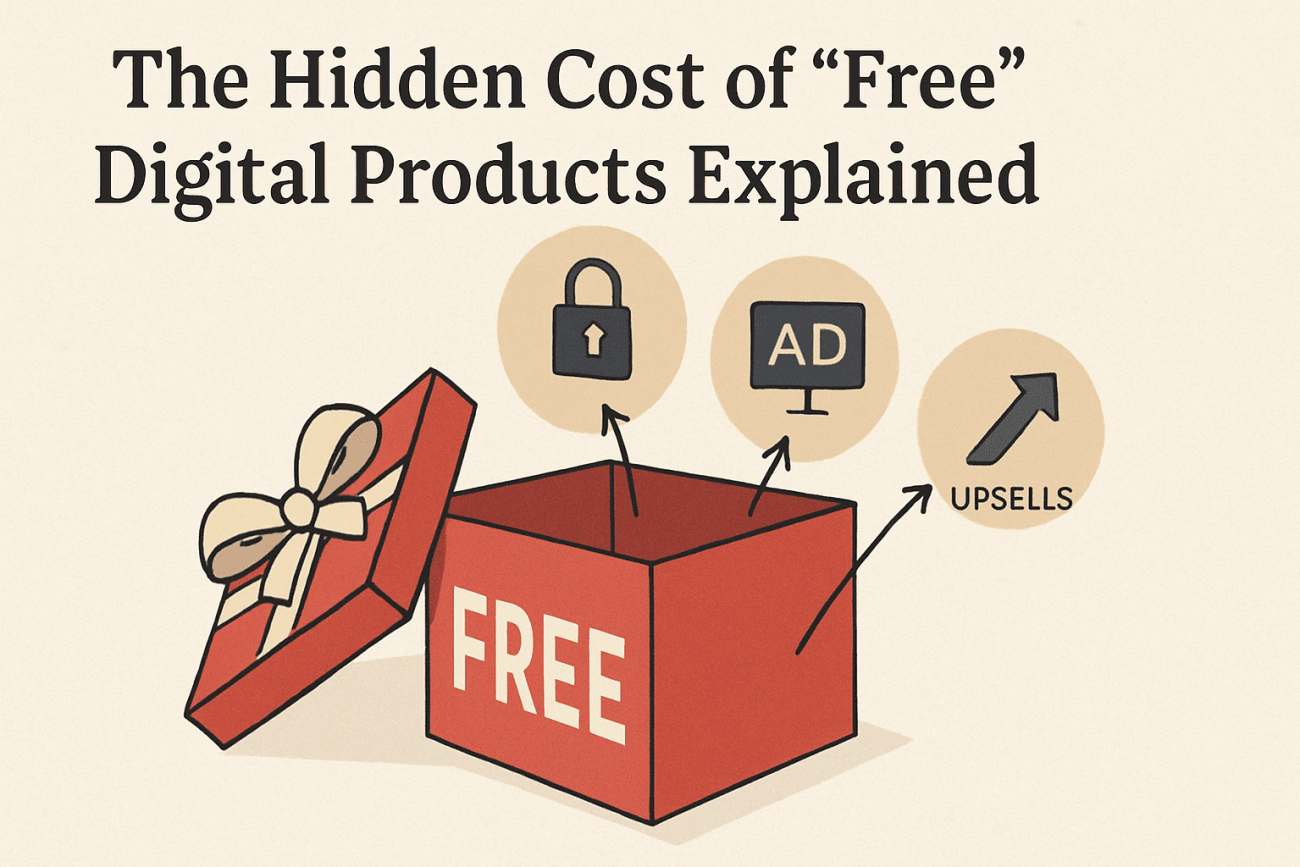
The “hidden cost of free apps” and software stems directly from the business model chosen by the company. These models are sophisticated and often overlap, but they generally fall into three main categories:
1. The Ad-Supported Model
This is perhaps the most common and easily recognizable model. Companies offer their product for free and generate revenue by displaying advertisements to the user.
- How it works: Platforms like Facebook, Instagram, and the free tier of YouTube use the vast amounts of data they collect about you to serve highly targeted ads. The more accurately they can target you, the more advertisers are willing to pay.
- The Hidden Cost: Attention and Manipulation. The cost here is your attention. Every ad is a distraction from your intended task, leading to reduced productivity and a fragmented experience. More insidiously, these platforms are designed to maximize your time on the app, often employing psychological techniques—known as “dark patterns”—to keep you scrolling, which increases the number of ads you see. Furthermore, targeted advertising can be used to influence your opinions, emotions, and purchasing decisions, sometimes encouraging unplanned or unnecessary spending.
2. The Freemium Model
The freemium model offers a basic, functional version of a product for free, while charging a subscription or one-time fee for “premium” features, advanced functionality, or increased limits.
- How it works: Companies like Spotify (free music with ads and limited skips), Dropbox (free storage with limited space), and Canva (free design tools with limited templates) use the free tier as a massive marketing funnel. They get you hooked on the convenience and utility of the basic product, making the eventual upgrade to the paid tier—the “upsell”—feel necessary.
- The Hidden Cost: Time and Frustration. The primary cost here is time and productivity loss. The free version is often intentionally limited or frustrating to use. You might spend extra time watching ads, manually deleting files to stay under a storage limit, or working around a missing feature that would save you hours. This friction is a deliberate design choice to push you toward the paid subscription. For businesses, relying on the free tier of a tool like Slack can mean losing access to critical message history, creating a technical debt that forces an expensive, sudden upgrade later.
3. The Data-Selling Model
This model is the most opaque and often involves the collection and sale of user data to third-party data brokers, research institutions, or marketing firms.
- How it works: Many free apps, especially mobile games or utility apps, collect far more data than they need to function. This data—including your precise location, device identifiers, and app usage patterns—is anonymized (sometimes poorly) and sold as large datasets. This is a primary revenue stream for many apps that don’t rely heavily on in-app purchases or subscriptions.
- The Hidden Cost: Privacy Erosion. This is the most significant “hidden cost of free apps.” You are trading your personal privacy for convenience. Every piece of data collected increases your digital footprint, making you more vulnerable to targeted marketing, price discrimination, and, in the worst-case scenario, security breaches.
The Four Pillars of Hidden Costs
Beyond the direct monetization models, the choice to use “free” digital products introduces four major categories of cost that are rarely discussed on a balance sheet.
1. The Cost to Your Privacy and Security
This is the most critical and often overlooked cost. When an app is free, its value proposition shifts from serving you to serving its advertisers or data buyers.
| Hidden Cost | Description | Real-World Risk |
|---|---|---|
| Excessive Permissions | Free apps often request access to data they don’t need (e.g., a flashlight app asking for your contacts or microphone). This is a clear sign that data collection is the goal. | Increased risk of surveillance and data misuse. |
| Data Breaches | The more data a company collects and stores, the larger the target it becomes for hackers. If a free service that stores your sensitive health or financial data is breached, the consequences can be severe, leading to identity theft or fraud. | Compromised personal information and financial loss. |
| Behavioral Profiling | Your data is used to build an “invisible profile” of your habits, vulnerabilities, and preferences. This profile can be used for purposes beyond advertising, such as political targeting or even influencing insurance rates. | Loss of autonomy and susceptibility to manipulation. |
2. The Cost to Your Professionalism and Brand
For individuals and small businesses, using free tools can sometimes undermine a professional image.
- Watermarks and Branding: Many free design, video editing, or document creation tools leave a prominent watermark (e.g., “Made with [Tool Name]”) on the final output. This signals to clients or customers that you are using the most basic, non-professional version of the software.
- Feature Limitations: Free versions often lack essential features like high-resolution exports, custom branding, or collaborative tools. This forces you to use clunky workarounds or deliver a sub-par product, which can damage your brand’s reputation for quality.
3. The Cost of Time and Effort
While a paid product might save you money, a free product often costs you time—a non-renewable resource.
- Manual Workarounds: If a free tool lacks a bulk-editing or automation feature, you are forced to perform tasks manually, one by one. This is a direct exchange of your time for the company’s subscription fee.
- Customer Support: Free users are typically last in line for customer support, if they receive any at all. When something goes wrong, you may spend hours searching forums or troubleshooting yourself, a cost that a paid subscription would eliminate with dedicated support.
- Switching Costs: Once you invest significant time and data into a free platform, the cost of switching to a better, paid alternative becomes enormous. This is a form of vendor lock-in, where the company uses your accumulated data and effort to keep you trapped in their ecosystem.
4. The Cost of Quality and Reliability
Free software, especially open-source or community-driven projects, can be excellent, but many commercial “free” products cut corners on quality.
- Lack of Updates and Maintenance: Free tools may be abandoned by their developers, leaving you with software that is vulnerable to security flaws or incompatible with new operating systems.
- Cloud Storage Egress Fees: Even “free” cloud storage services often have hidden costs related to data retrieval. If you need to download a large amount of data—a process known as egress—you may be hit with unexpected fees that can quickly exceed the cost of a premium plan. This is a common trap for users who rely on free tiers of services like Amazon Web Services (AWS) or Google Cloud Platform (GCP) without understanding the pricing structure.
Actionable Guidance: Making Smarter Choices
Understanding the hidden costs is the first step; the next is applying that knowledge to your daily digital life. Here is a practical guide for navigating the “free” landscape:
1. Scrutinize Permissions and Policies
Before you download any free app, especially on mobile, perform a quick audit:
- Review Permissions: Does a simple game need access to your microphone? Does a calculator need your location? If the requested permissions seem excessive, decline the app.
- Check the Privacy Policy: While often dense, look for keywords like “share,” “sell,” “third-party data brokers,” and “behavioral advertising.” If the policy is vague or overly broad, treat it as a red flag.
- Limit Access: On modern operating systems, you can often grant permissions only “while using the app” or restrict access to specific data types. Always choose the most restrictive option possible.
2. Choose Your “Free” Model Wisely
Not all free models are equally costly. Prioritize models where the cost is transparent and manageable:
| Model to Prioritize | Why It’s Better | Model to Be Wary Of | Why It’s Riskier |
|---|---|---|---|
| Freemium (with clear limits) | The cost is transparent: you pay with time/frustration, but your data is often less aggressively sold than in ad-supported models. | Ad-Supported | The cost is your attention and your data, which is constantly being harvested and sold to the highest bidder. |
| Donationware/Open Source | The revenue model is based on goodwill and community support, aligning the developer’s interest with the user’s. | Data-Selling | The cost is your privacy, and the business model is inherently opaque and difficult to audit. |
3. Invest in Privacy-First Alternatives
For sensitive areas of your digital life, it is almost always worth paying a small fee for a product that explicitly promises not to sell your data.
- Messaging: Consider alternatives like Signal or Telegram for end-to-end encrypted communication, which rely on donations or user fees rather than advertising.
- Email: Services like ProtonMail offer secure, encrypted email where the business model is a paid subscription, not data mining.
- Productivity: For professional work, invest in paid versions of essential tools. The money you spend on a subscription will likely be far less than the time you save or the brand damage you avoid by using a limited free version.
4. Perform a Cost-Benefit Analysis
Before committing to a free product, ask yourself these three questions:
- What is the time cost? How much time will I spend watching ads, managing limitations, or finding workarounds?
- What is the data cost? What sensitive information (location, health, contacts) am I giving up? Is this data worth the convenience?
- What is the switching cost? If I use this free tool for a year, how difficult and expensive will it be to move all my data to a better service later?
By approaching “free” digital products with a realistic, critical mindset, you move from being a passive product to an informed consumer. You gain control over your digital life, protect your privacy, and ensure that the tools you use are working for you, not against you. The true cost of a digital product is not zero; it is the sum of the financial, temporal, and privacy trade-offs you accept. Choose wisely.
References
[1] Direct Project. The Hidden Cost of “Free” Apps – How our personal data fuels business models, and what “responsible” app use looks like. https://directproject.eu/the-hidden-cost-of-free-apps-how-our-personal-data-fuels-business-models-and-what-responsible-app-use-looks-like/
[2] Syndicode. How Do Apps Make Money? 11 Best Monetization Strategies. https://syndicode.com/blog/how-do-apps-make-money/
[3] Backblaze. The Hidden Cost of Cloud Storage: What 400+ IT Leaders Wish They Knew Sooner. https://www.backblaze.com/blog/the-hidden-cost-of-cloud-storage-what-400-it-leaders-wish-they-knew-sooner/
[4] Entrepreneur. The Hidden Costs of Free Software. https://www.entrepreneur.com/business-news/the-hidden-costs-of-free-software-small-business-software/204582
[5] Perpet.io. Best Monetization Strategies of 2025 for Tech Startups. https://perpet.io/blog/best-monetization-strategies-of-2025-for-tech-startups-what-actually-works-and-whats-dead/