Last reviewed and updated on January 6, 2026. Note: Sweepstakes laws and platform terms of service vary significantly by country and region. For example, specific registration and bonding requirements exist in Florida, New York, and Rhode Island for high-value prizes. Always consult the official rules of each individual promotion.
There is a unique kind of heartbreak in the world of “free stuff”: receiving a notification that you have won a major prize, only to have it snatched away minutes later because of a technicality. For beginners, sweepstakes often feel like a game of pure luck, but for those who have been “sweeping” for years, it is a game of precision.
In 2026, as brands use more sophisticated automated systems to filter entries, the margin for error has never been slimmer. This guide breaks down the most common—and often invisible—mistakes that lead to disqualification, helping you ensure that when your name is finally drawn, the prize actually makes it to your front door.
Who This Guide Is For (and Who It’s Not)
This guide is for:
- Beginners who are just starting to enter online giveaways and want to avoid “rookie” errors.
- Early intermediates who enter regularly but haven’t seen a win yet and suspect they might be getting filtered out.
- Hobbyists looking for a realistic, no-nonsense look at how the sweepstakes industry operates behind the scenes.
This guide is NOT for:
- Professional “Botters” or anyone looking for ways to cheat the system. We do not support automation or multiple-identity tactics.
- People looking for “Get Rich Quick” schemes. Sweepstakes are a hobby, not a career or a reliable source of income.
- International entrants looking for loopholes to enter U.S.-only contests.
The Reality of “Free”: Understanding the Trade-offs
Before we list the mistakes, we must be transparent about the “cost” of entering sweepstakes. While you aren’t paying with cash, you are trading other valuable assets:
- Privacy and Data: Brands run sweepstakes primarily to build marketing lists. By entering, you are often consenting to receive newsletters and having your demographic data analyzed.
- Time: Entering 50 sweepstakes a day is a significant time commitment. The “return on investment” (ROI) for your time is statistically very low.
- Inbox Clutter: Unless you use a dedicated email address, your primary inbox will quickly become overwhelmed with promotional offers.
- Security Risks: Not every “giveaway” is legitimate. Scammers frequently use the lure of free prizes to phish for Social Security numbers or bank details.
“The most successful sweepers aren’t the luckiest; they are the ones who read the fine print while everyone else is just clicking ‘Submit’.” — Common sentiment in the r/Sweepstakes community.
1. The “Identity” Trap: Multiple Accounts and Shared Logins
The number one reason for disqualification in 2026 is attempting to “stuff the ballot box.”
Creating Multiple Accounts
Most reputable sweepstakes, including daily prize apps like ZipSweep, have a strict “one account per person” rule. Modern anti-fraud systems track IP addresses, device IDs, and browser fingerprints. If you create three accounts using different emails but the same Wi-Fi, all three will likely be flagged and disqualified.
- The Mistake: Thinking that “more accounts = more chances.”
- The Reality: In reality, “more accounts = automatic ban.” Brands would rather disqualify a legitimate winner than risk the integrity of their promotion.
Shared Household Entries
Many rules state “one entry per household” rather than “per person.” If you and your spouse both enter from the same address, you might both be disqualified.
- Actionable Advice: Always check the “Eligibility” section of the Official Rules. If it says “per household,” pick one person to be the designated “sweeper” for that prize.
2. Technical Disqualifiers: VPNs and Location Spoofing
In an era of remote work and privacy tools, many users leave their VPNs (Virtual Private Networks) on 24/7. This is a fatal mistake for sweepstakes.
Using a VPN or Proxy
Sweepstakes are often legally restricted to specific geographic regions (e.g., the 50 United States and D.C.). If your VPN makes it look like you are in London while you are actually in Chicago, the system will automatically flag your entry as “out of region.”
- Why it happens: Sponsors must comply with strict state and federal laws. If they award a prize to someone outside the legal area, they can face massive fines.
- The Fix: Disable your VPN before visiting any sweepstakes site or app.
Outdated or Incorrect ZIP Codes
For location-based sweepstakes, your ZIP code is your identity. As noted by ZipSweep’s guide to entry mistakes, using an outdated ZIP code in your profile can invalidate a win, especially if the prize is tied to a “local rollover” or regional drawing.
3. The “Fine Print” Failures: Eligibility and Deadlines
It sounds simple, but thousands of winners are disqualified every year because they didn’t meet the basic requirements listed in the rules.
Age and Residency Requirements
If a sweepstakes is “21+” and you are 20, do not enter. Even if you win, you will be required to provide a government-issued ID to claim the prize. There is no “grace period” for birthdays that happen after the entry but before the drawing.
- Attribution: Legal experts at Olshan Law emphasize that sponsors are legally bound by their own rules; they cannot “make an exception” for you without risking a lawsuit from other entrants.
Missing the “Claim Window”
Winning is only half the battle. Most sweepstakes have a very tight window to claim your prize—sometimes as short as 24 hours.
- The Mistake: Not checking your “Promotions” or “Spam” folders.
- Actionable Advice: Whitelist the email addresses of major sweepstakes sponsors. If you use an app, ensure push notifications are turned ON. As community members often share on forums like SurveyPolice, “A win you don’t see is a win you didn’t get.”
4. Content and Social Media Mistakes
If a sweepstakes requires you to post a photo, write a caption, or use a hashtag, the rules become even more complex.
Copyrighted Material in Entries
If you enter a photo contest and there is a copyrighted song playing in the background or a visible logo on your t-shirt (other than the sponsor’s), you are likely disqualified.
- Why? The sponsor wants to use your entry for marketing. If your entry contains someone else’s intellectual property, the sponsor can’t use it legally.
- The Fix: Keep your background clean and your clothing neutral.
“Ghosting” on Social Media
If a contest requires you to “Follow and Tag a Friend,” and you immediately unfollow the brand after entering, their automated “winner picker” might not be able to find your account when the drawing happens.
- The Fix: Stay followed until at least one week after the winners are officially announced.
5. The “Human” Errors: Typos and Dishonesty
Typos in Contact Information
If you mistype your email address as gmal.com instead of gmail.com, the sponsor has no way to tell you that you’ve won. They will not spend hours trying to track you down; they will simply move to the next “Alternate Winner.”
- Actionable Advice: Use “Auto-fill” features with caution. Always double-check your phone number and email before hitting submit.
Providing False Information
Some entrants use “fake” names or burner phone numbers to protect their privacy. While understandable, this is a disqualifying offense.
- The Reality: To claim any prize over $600 in the U.S., you must fill out an IRS Form 1099. If the name on your entry doesn’t match your tax ID, you cannot legally claim the prize.
6. Advanced Legal Pitfalls: Registration and Bonding
Many beginners don’t realize that high-value sweepstakes are heavily regulated at the state level. If a sponsor fails to follow these rules, the entire sweepstakes could be voided, or residents of certain states could be excluded.
The $5,000 Threshold (FL and NY)
In Florida and New York, if the total prize pool of a sweepstakes exceeds $5,000, the sponsor is required by law to register the promotion and obtain a “surety bond.” This bond ensures that the prizes will actually be awarded.
- The Mistake: Entering a high-value sweepstakes that hasn’t been registered. If you live in NY or FL and the sponsor skipped this step, you are technically ineligible to win.
- Attribution: According to Stradling Law, these laws are designed to protect consumers from “phantom” prizes, but they also create a hurdle for smaller brands who might accidentally exclude entire states to avoid the paperwork.
The Rhode Island “In-Store” Rule
Rhode Island has a unique requirement: any sweepstakes with a prize value over $500 that is conducted in a retail store must be registered with the state.
- The Fix: If you are a Rhode Island resident, always check the “Void Where Prohibited” section of the rules. You’ll often see “Void in RI” for mid-sized prizes because the sponsor didn’t want to deal with the $500 registration threshold.
7. Identifying and Avoiding Sweepstakes Scams
The biggest “mistake” isn’t just getting disqualified; it’s getting scammed. In 2026, scammers have become incredibly good at mimicking legitimate brands.
The “Processing Fee” Red Flag
A legitimate sweepstakes will never ask you to pay money to receive your prize. This includes “taxes,” “shipping fees,” or “handling charges.”
- The Reality: If you win a car, you will pay the taxes to the IRS when you file your return, not to the company that gave you the car.
- Attribution: The U.S. Postal Inspection Service warns that any request for upfront payment via wire transfer, gift card, or cryptocurrency is a 100% guarantee of a scam.
The “Fake Check” Scheme
Scammers will sometimes send you a realistic-looking check for $5,000. They tell you to deposit it, keep $1,000 for yourself, and wire the remaining $4,000 back to them to cover “fees.”
- The Trap: The check is fake. It will bounce a few days later, but the $4,000 you wired is gone forever.
- The Fix: Never wire money to someone who sent you a check.
Summary Table: Common Mistakes vs. The Winning Way
| The Mistake | Why It Disqualifies You | The Winning Way |
|---|---|---|
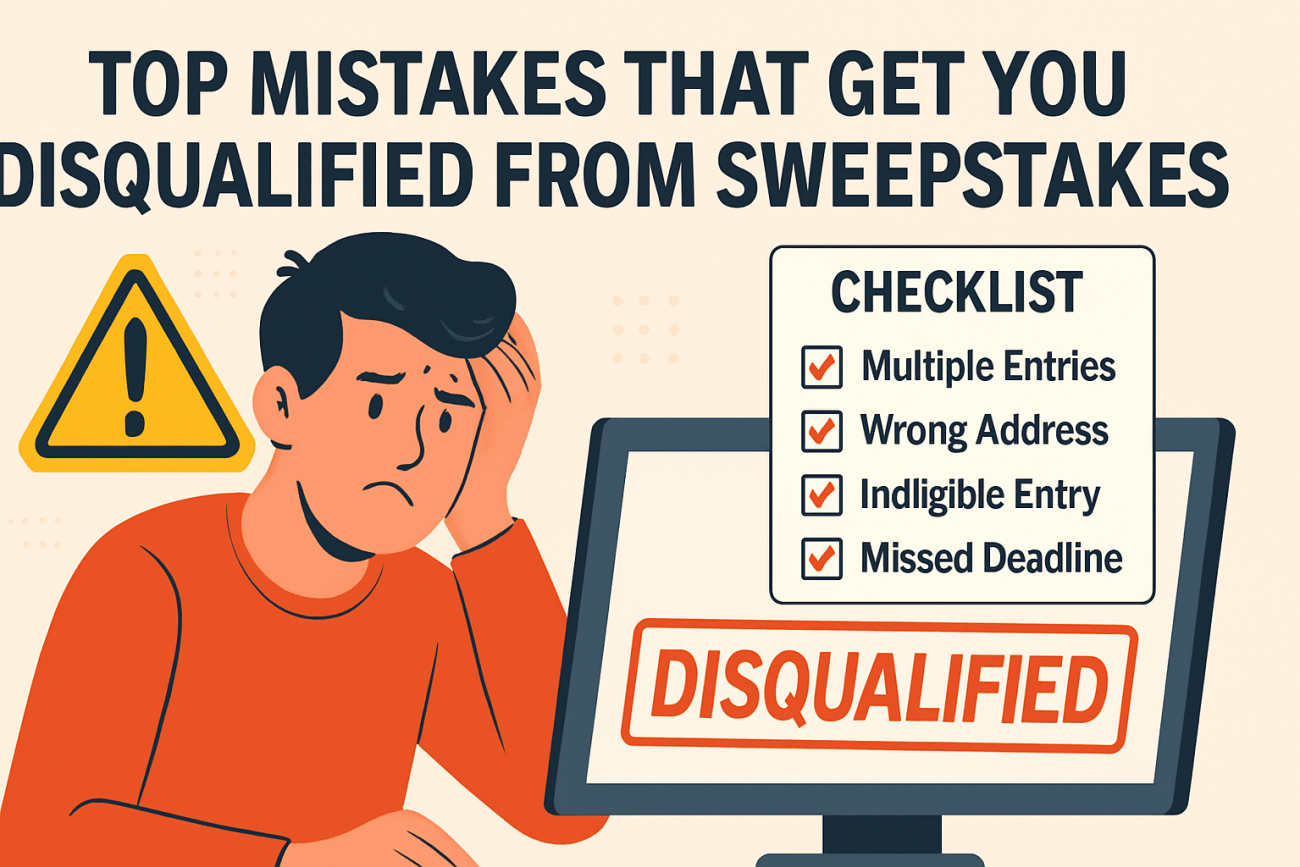
| Multiple Accounts | Flagged as fraud/cheating. | One account, one person, one device. |
| VPN Usage | Masks your legal residency. | Turn off VPNs before entering. |
| Ignoring “Spam” Folder | Missed the 24-48 hour claim window. | Check your email daily; whitelist sponsors. |
| Ineligible Age/Region | Legal requirement for the sponsor. | Only enter what you are legally eligible for. |
| Copyrighted Backgrounds | Sponsor cannot use the entry for ads. | Use clean, neutral backgrounds for photos. |
| Paying “Fees” | It’s a scam, not a sweepstakes. | Never pay to receive a “free” prize. |
Real-World Constraints: Taxes and Costs
It is a common misconception that “free” means “zero cost.” In the United States, sweepstakes winnings are considered taxable income.
- The $600 Rule: If you win a prize valued at $600 or more, the sponsor is required by law to report it to the IRS. You will receive a 1099-MISC form at the end of the year.
- The Trade-off: If you win a $50,000 car, you might owe $10,000 or more in taxes. If you don’t have the cash to pay the taxes, you might have to sell the prize or decline it.
- Expert Insight: Always set aside 25-30% of a prize’s value for taxes if it is a cash prize. For physical prizes, consult a tax professional.
User Testimonials: Lessons from the Community
Note: The author of this article did not participate in these experiences; these are summaries of documented community discussions from platforms like Reddit, Quora, and specialized tech forums.
- The “Spam” Tragedy: “I won a $1,000 gift card from a major retailer. I didn’t see the email because it went to my ‘Junk’ folder. By the time I found it three days later, they had already awarded it to someone else. Now I check my spam every single morning.”
- The VPN Victim: “I was entering a local radio contest while at work. My office uses a VPN that routes through another state. I won, but when they checked my IP logs, they saw I was ‘out of state’ and disqualified me on the spot.”
- The Typo Terror: “I won a trip to Hawaii, but I had mistyped my phone number by one digit. Luckily, they emailed me too, but I almost missed the deadline because I was waiting for a call that never came.”
- The “Household” Heartbreak: “My roommate and I both entered a ‘one entry per household’ sweepstakes for a new gaming PC. I won, but because we both entered from the same address, the sponsor disqualified both of us for ‘ballot stuffing’.”
Final Thoughts: How to Win in 2026
Winning sweepstakes is a marathon, not a sprint. The “pros” who win consistently aren’t using magic tricks; they are simply the most organized.
To maximize your chances:
- Create a dedicated email address (e.g.,
yourname.sweeps@gmail.com) to keep your primary inbox clean and focused. - Set a “Daily Check” alarm on your phone to review your email and apps for win notifications.
- Read the first three paragraphs of the rules for every contest. That is where the “deal-breakers” (age, residency, entry frequency) are hidden.
- Keep a “Win Log” to track your entries and any prizes you are expecting. This helps you spot fake “win” notifications from scammers.
By avoiding these common pitfalls, you move from being a “random clicker” to a “strategic entrant.” Stay honest, stay organized, and remember: the only way to guarantee you won’t win is to get yourself disqualified.
Disclaimer: This article is for informational purposes only and does not constitute legal or financial advice. Sweepstakes rules are subject to change. While we strive for accuracy, the author is not responsible for any disqualifications or losses resulting from the use of this information. Always use updated security software and trust your instincts—if a “win” feels like a scam, it probably is.